• About

Catherine Evans

~ Creative Artist and Food & Lifestyle Blogger

Catherine Evans

Tag Archives: Health foods

A Healthy Winter Salad

29 Tuesday Nov 2022

Posted by catherineevans63 in Food and Drink

≈ Leave a comment

Tags

Antioxidants, conversation, Fermenting, Food, Gut Health, Health foods, Healthy, Healthy Bacteria, Healthy Eating, Healthy Living, Homemade salad dressing, Immune system, Probiotics, Recipe, Salad, Vegetables

Salad vegetables at any time of year are a good source of insoluble fibre, which helps you to maintain a healthy digestive tract and reduce LDL, or bad, cholesterol. By adding nuts, seeds or beans (maybe even some pea shoots or alfafa sprouts) to your salads you will also get a boost of soluble fibre which helps to lower cholesterol and keep blood sugar well-balanced, which is particularly important for diabetics and more generally to control mood swings, irritability, depression and cravings for sugary things. Other symptoms of blood sugar imbalance include fatigue, difficulty concentrating, feeling hungry after only a few hours of eating, blurred vision and fat storage around the midriff. These are also symptoms of clinical hypoglycaemia which is when blood sugar falls below below 55 mg/dL. Salad vegetables contain high levels of water providing our bodies with hydration necessary for youthful skin tone and various basic bodily functions such as urination and bowel movement.

Submitting form

Salads are so easy to prepare at home and a salad a day provides multiple health benefits at any time of the year. The main difference of course is that the various salad vegetables have their seasons, which is when they will be at their most nutritious especially if they are organic or homegrown and free from chemicals and pesticides rather than flown in from hundreds or even thousands of miles away, although even these will have some nutritional value and not everyone is able to afford to buy organic or grow their own produce, Please remember to rinse all your vegetables thoroughly in clean, cold running water before preparing in order to get rid of any grit, soil and pests or residue of chemicals and pesticides.

One of the best things to include in your salad is leafy greens rich in Vitamin K such as baby spinach, Romaine lettuce or watercress in the summer and shredded kale in the winter. Low levels of Vitamin K have been linked to low bone density in women and just one cup of leafy greens per day will promote bone growth and improve the performance of the mitochondria which are the tiny cell structures that help us produce energy and effective muscle maintenance and growth. Romaine lettuce in particular contains significant levels of folate which helps to prevent stroke and cardiovascular disease. Grated or fine julienne strips of carrot, beetroot and celeriac and some finely shredded red cabbage also pep up your winter salad and help to make it super nutritious. Aim to make your salads as colourful as possible to maximise your intake of vitamins and minerals and to increase the level of powerful antioxidants in your blood. “Red” fruits and vegetables such as tomatoes, red and orange peppers, carrots, stone fruits like peaches and apricots and berries such as blueberries, pomegranates and cranberries are of particular nutritional benefit as they contain carotenoids such as Vitamin A, beta-carotene, lycopene, lutein and zeaxanthin as well as providing the body with antioxidant and anti-inflammatory attributes. Carotenoids – which are also found in the green leafy salad vegetables – also help the eyes to adjust between light and dark and to filter out high intensity light levels and thus protecting the eyes from the formation of damaging free radicals.

A fibre-rich salad will help you feel full faster so you will consume less calories than you might otherwise and including as many raw vegetables as possible will maximise their positive effects. If you can, try incorporating a handful of chopped nuts or seeds in your salad and a homemade salad dressing provide a good source of healthy oils, as does adding some sliced avocado which enables the body to absorb all the protective compounds, lutein and phytochemicals it needs for optimal health and wellbeing and a strong immune system. Nuts and seeds are also a good source of zinc and selenium, which help to prevent heart disease and develop antibodies in the immunocompromised, improve metabolism and thyroid function. Selenium also contains antioxidants that help to boost male fertility by increasing the sperm’s mobility to help it to swim and fertilise the ova. Zinc helps to keep white blood cells healthy to fight disease and infection, enable wound healing and encourage cell production in the body. A paper published in 2003 in the Folia Microbiologica noted that zinc and selenium are both important in modulating immune function and selenium in particular is necessary for the functioning of three different types of immune cells – neutrophils (they comprise 40% of white blood cells and 60% of the immune cells in the blood), macrophages (they help to eliminate foreign substances and microorganisms and other harmful organisms by overwhelming them and triggering an immune response) and ‘natural killer’ (NK) cells (lymphocites, which belong to the ‘B’ and ‘T’ cell family but respond quickly to a whole host of pathological challenges such as killing virally infected cells and detecting and controlling early signs of cancer).

One-Time
Monthly
Yearly

Make a one-time donation

Make a monthly donation

Make a yearly donation

Choose an amount

¤5.00
¤15.00
¤100.00
¤5.00
¤15.00
¤100.00
¤5.00
¤15.00
¤100.00

Or enter a custom amount

¤

Your contribution is appreciated.

Your contribution is appreciated.

Your contribution is appreciated.

DonateDonate monthlyDonate yearly

TIP: Try making your own salad dressing. To a small jar add 6 tsp extra virgin olive oil, 3 teaspoons of raw apple cider vinegar, 3 tsp honey, 3 tsp Dijon or wholegrain mustard, season with salt or pepper, screw the lid on and shake thoroughly to combine. Depending on what salad you are making you might also like to add a squeeze of fresh lemon, lime or orange juice and this kind of salad dressing also stops fruits such as chopped avocado and apple from browning. Also try adding antioxidant-rich chopped herbs to your dressings and salads such as coriander, thyme, dill, garlic, chives, rosemary and mint (which pairs particularly well with apple) to bring a further dimension to your plate.

Below is a basic winter salad using some of the fresh raw seasonal fruit and vegetables that Dan and I had bought from our local farm shop at the weekend or had delivered from Riverford Organic. I dressed the salad with my basic homemade salad dressing (as detailed in the above paragraph), adding a dollop or two of home-fermented cabbage with its health-giving probiotics and a handful each of walnuts and mixed seeds for a bit of crunch. Quantities are random – it is entirely up to you how large you want your salad to be or for how many people you are catering – but this one will feed two.

Ingredients

  • A wedge of red cabbage, thinly shredded
  • A good handful of organic curly kale, thinly shredded
  • Organic carrot, sliced into thin julienne strips
  • Large stick of celery, chopped
  • 2 small local apples, cored and chopped
  • handful of organic black grapes, halved
  • Handful of walnuts, roughly chopped
  • Handful of mixed seeds
  • Two tablespoons of fermented cabbage (optional) – my homemade one is fermented with grated carrot and cumin seeds.
  • Salad dressing

1. Wash and prepare the fruits and salad vegetables and place in a large bowl.

2. Add the roughly chopped walnuts, drizzle in the salad dressing and mix into the salad to combine thoroughly.

3. Pile the salad into the middle of one platter or two large plates.

4. Spoon the fermented cabbage (if using) on to the bed of salad and sprinkle with mixed seeds.

COOK’S TIPS:-

This salad is vegan if served on its own or with sliced avocado or some falafels.

This main course salad can also be served with shaved parmesan or vegetarian substitute, some hot smoked mackerel or salmon or even charcuterie. However you choose to present your salad, it is very versatile!
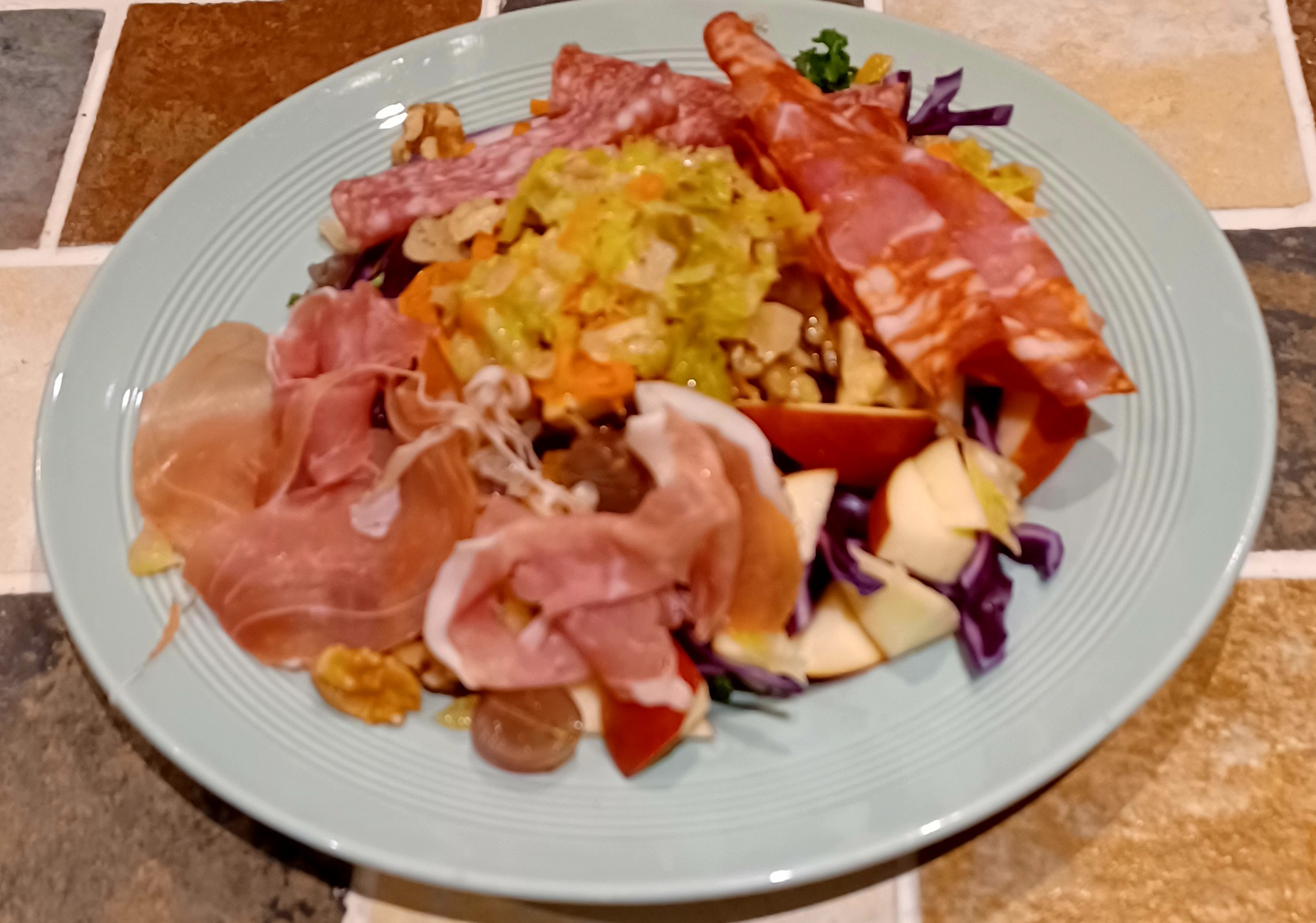
Dan had Italian charcuterie with his salad!

Buon appetito!

Catherine

HELEN’S SEEDED BREAD MIX

17 Monday Oct 2016

Posted by catherineevans63 in Food and Drink, Uncategorized

≈ Leave a comment

Tags

Bread mix, Coeliac, FoodByHelen, Gluten-free, Gluten-free bread, Health foods, Healthy, Helen's Foods, Irish, Linseed, Natural, Seeded bread mix, Seeded loaf, Soda bread, traditional

Front of pack
Front of pack
Rear of pack
Rear of pack
Add milk, egg, oil
Add milk, egg, oil
Mix everything together
The batter is ready
The batter is ready
Pour into tin and mark with knife
Leave the loaf to cool
Ready to eat
Ready to eat

Last weekend, I placed my online order with ASDA and, whilst browsing the impressive array of groceries in the gluten-free ‘aisles’, I caught sight of Helen’s Gluten Free Seeded Bread Mix for £2.45. Curious to test it out, I added it to my order.

The Seeded Bread is one of three available bread mixes – the others being Sandwich and Brown Bread – and, like the other products in the range, are gluten- and wheat-free.

The price of a gluten-free loaf has come down considerably in the last year or two, but not all are appetising. My favourites to-date have been Genius and Marks & Spencer, although the Asda loaf isn’t bad either. Some of them though have a strange, dry cardboard/powdery texture, unpleasant to my taste buds.

Helen’s Seeded Bread Mix weighs 300g net and will produce a 550g loaf, so at £2.45 is still reasonably priced for a brand name. The mixes are produced by Virginia Health Food Ltd, Carrigaline, County Cork, Eire (Republic of Ireland, for anyone who doesn’t know).

Helen, it should be noted, is a real person, not a marketing ploy. According to her website, Helen O’Dowd was raised on a farm and is a qualified nutritionist, food scientist and mum. Her product is based on a fundamental belief that a diet and lifestyle based on natural produce is paramount in maintaining one’s health and wellbeing and, as a busy working mum, she recognises how difficult it can be to make sure that the whole family receives the right balance of nutrients each day.

The Helen’s products are made using linseed, or flaxseed, because it contains ancient gut-soothing properties commonly found in traditional medicine for thousands of years. The linseed is made even more precious by combining its ancient properties with modern cold-milling technology, which enable the highly functional nutrients within the seed to be more readily absorbed.

The front and back of the bread mix packet are colourful and informative and the packet itself is composed of a wax paper-type plastic that is recyclable as mixed plastics. The bread mix is also yeast free, making it suitable for anyone with a yeast intolerance, and is high in fibre. The packet claims the mix is “ready to bake in 2 minutes” but by the time I had gathered together and mixed all the ingredients and poured the mixture into the loaf tin, it was nearer five.

The ingredients and nutrition information (based on a loaf containing buttermilk and butter) are also clearly listed on the back of the packet along with an image of Helen herself, which gives the product a more homely and familiar appeal. There is also a smartphone scan for recipe ideas. An average 100g slice will provide you with 262 calories, 9.3g fat (of which 1.5g are saturates), 31.8g carbohydrate (of which sugars are 3.0g), 7.5g fibre, 8.9g protein and 1.0g salt. The ingredients are: Potato starch, Rice flour, Linseed flour, Mixed Seeds 22% (Pumpkin seeds, sunflower seeds, linseed), Sugar, Raising Agents – Sodium bicarbonate, disodium diphosphate, sea salt, Stabiliser: Xanthan gum.

Helen professes to use “top quality, nutrient dense, wholesome ingredients so you won’t find any synthetic stabilisers, preservatives or flavourings in any Helen’s products.” Now this ethos certainly fits my own philosophy; I endeavour to steer clear from additives and use only natural ingredients as much as possible. Certainly, nearly all the listed ingredients are familiar to me, but what on earth is disodium diphosphate? If disodium diphosphate is indeed a natural additive, from what is it harvested and how is it produced?

According to Wikipedia, disodium pyrophosphate (sodium acid pyrophosphate) is an inorganic compound comprising sodium cations and pyrophosphate anion (whatever that is). It is a solid, white and water-soluble compound that helps to maintain acidity and supplement nutritional values with widespread use in the food industry. It is used in various grades as a leavening-agent in baking powders and combined with sodium bicarbonate releases carbon dioxide. Grades vary according to the speed of action required. In the United States, the compound is “generally regarded as safe” for use in the food industry. As well as its use in baked goods, it is used in tinned seafood to maintain colour and prevent purge during the canning process. It can be used in the curing of prepacked meats, converting sodium nitrate to nitrate and enabling the meat to hold more water; it is also used in hash browns and other potato products to prevent the potatoes from darkening. In baking powder, disodium pyrophosphate is often labelled as the additive E540. Well I never knew that . . . sounds a bit like a chemical to me! However, I should like to point out that this is only my opinion and I would be interested in hearing from Helen herself or anyone else ‘in the know’, who might enlighten me further.

The baking method for the seeded loaf is detailed clearly on the reverse of the packet. To make the loaf, simply add one beaten egg, 1 tablespoon of oil or melted butter and 260ml milk or buttermilk. Although this recipe is clearly not vegan, you could substitute soya or almond milk for the dairy and replace the egg with a tablespoon of vinegar (which also acts as a raising agent and stabiliser) if you can live with the disodium diphosphate and Xanthan gum (incidentally, chia seeds are a good alternative to Xanthan gum in recipes).

So on Friday evening I preheated the oven to 200C (400F/Gas Mark 6). I then greased my 2lb loaf tin with vegetable oil. As my tin isn’t non-stick, I oiled it really well. In a bowl I whisked one medium free-range egg and to it I added the milk and vegetable oil and the bread mix and gave everything a good stir. The recipe doesn’t state whether the egg should be medium or large but as I had only medium I hoped for the best. The mix was quite runny at first but I mixed it for two or three minutes it became smoother and thicker but was still on the loose side when I poured it into the tin. The mixture reached about one-third of the depth of the tin and in hindsight I could have used my ceramic loaf-tin-shaped dish but the recipe doesn’t state what size tin to use. In any case, while a 1lb loaf tin would produce a deeper loaf it is not likely that the cooking time would be much reduced, if at all, as a consequence.

I endeavoured to make a deep slit in the dough lengthways with a knife but as the batter was quite loose, the slit was not pronounced. I sprinkled some sesame seeds on top, as per the recipe, but if you have none available you could perhaps use a sprinkling of sunflower or pumpkin seeds or a handful of linseed. I popped the loaf tin on the middle shelf of the oven and after about 35 minutes, removed the loaf from the oven and tested it with a skewer and, although the loaf was a pleasant baked golden brown, the skewer did not come out completely clean so I returned it to the oven for a further 10 minutes so the cooking time of 40-45 minutes is accurate. Oven temperatures do vary though and had I baked the loaf in my last oven, which was hotter, even at the same temperature on the dial 30-35 minutes would have sufficed.

After a further 10 minutes, I removed the loaf and retested it; it was ready. Leaving the tin a few minutes’ to cool slightly before handling, I ran a knife blade around the edges of the loaf and shook it out on to a wire rack to cool completely.

The loaf had a pleasant, home baked aroma and was well-risen with a good, deep golden brown crust. It cut cleanly with a bread knife and I could clearly see a good quantity of seeds running through the crumb, which was nice and light – not heavy or leaden at all – and had a round, nutty flavour with none of that aforementioned unpleasant papery texture I had been apprehensive about. In fact, neither myself nor Dan would have realised it was gluten-free unless we had been told. We ate ours with local butter and a mixed salad for supper, but Helen recommends topping the bread with banana or jam for breakfast or perhaps spreading with hummus and guacamole and topping with tomato or some fresh basil as a lunchtime treat; the bread is also fantastic sliced thinly for gluten-free party nibbles. I would present these topped with a little smoked salmon and cream cheese with dill, or perhaps some homemade artichoke pate or a teaspoon or two of finely chopped roasted Mediterranean vegetables.

The real test of the bread would come on Saturday, when it was maybe 16 hours old. I was exhibiting my arts and crafts at the Kingston-on-Thames Yoga and Vegan Food Festival and took with me a sandwich made from two slices of the gluten-free loaf spread with Whole Earth crunchy peanut butter and I have to say it was still delicious and free from a papery texture. The last of the bread also toasted well for breakfast yesterday morning, so an excellent result!

Although I normally hand bake my own bread from scratch without any artificial additives, I would definitely use this bread mix again were I pressed for time purely because it tastes so good and I will probably order one in – perhaps the sandwich loaf mix to see what that is like.

In addition to the bread mixes, Helen’s fantastic range includes a Breakfast Protein Crunch Mix with Raspberries and Breakfast Seed Toppings with Goji berries (both of which I think might go well as a topping on organic porridge), Gluten Free Scone Mix, Gluten Free Chocolate Cupcake Mix, Gluten Free Dessert Crumble Mix and Gluten Free Pastry Mix, all designed to help make mealtimes and teatime treats as convenient and nutritious as possible. They are certainly useful products to keep in the storecupboard to use when one is pressed for time and needs to prepare something in a hurry, or for those of you who are not confident cooks as the recipe mixes contain clear step-by-step instructions to help you produce perfect results time after time.

Helen’s range is also ideal for those who suffer from gluten intolerance or sensitivity or from coeliac disease. Some people, such as myself, find that eating wheat can leave them feeling bloated and uncomfortable and can produce flatulence, acid reflux or even lethargy. I have had a wheat intolerance all my life ever since I was 3 months old, when my mother added rusk to my bottle which caused me to suffer a ruptured bowel; I am also sensitive to soya and sugars, including lactose so for me, it is wiser to follow a gluten-free or low gluten diet as far as possible; I seem to be able to tolerate spelt.

The main protein in wheat, gluten originates from the Latin word for ‘glue’. It provides bread dough with the elasticity to trap in air to give the bread its familiar open texture.

Coeliac disease, meanwhile, is a condition that affects the small intestine and causes a permanent immune reaction to ingested gluten. If coeliac disease is left untreated it can result in damage to the lining of the small bowel, causing lack of absorption of essential nutrients and the development of anaemia, osteoporosis and other medical conditions including chronic joint pain and arthritis. It is possible for coeliac disease to develop at any age, including in those who for most of their lives have always eaten products containing gluten. The only effective treatment for a coeliac is to completely avoid wheat and foods containing gluten.

Today, coeliac disease is being diagnosed more and more and although statistics indicate that 1 in 100 people suffer from the condition, it seems to be even more common in people of Irish descent – despite my estimated 45% European autosomal DNA, I do have some Scots-Irish heritage.

Now it has suddenly dawned on me that the fibromyalgia with which I have finally been diagnosed might actually be a symptom of coeliac disease, especially given my intolerance to wheat products and the like, and I am thinking that I might see my GP about taking the blood test (about the only blood test I haven’t actually been put through in the last few years for my endocrine system woes), if only for peace of mind. At least then I might know for sure with what I am dealing and what further adjustments to my lifestyle I may need to make in order to maintain optimum health and vitality.

Some spectators believe that dietary problems have been aggravated or even caused by the Chorleywood Method of producing bread for the mass market, compared to the more traditional, artisan-produced loaf.

The Chorleywood process (CBP) of mass-producing bread dough was developed in 1961 by the British Baking Industries Research Association in the village of Chorleywood, Hertfordshire. At the time, few wheat varieties in Britain were of sufficient quality to produce high-quality bread products, and the CBP allowed a much greater proportion of lower-protein domestic wheat grain in the flour. In 2009 some 80% of the bread in the United Kingdom was produced by this method. Instead of the older bulk fermentation process, the CBP is capable of using wheat containing lower protein and produces bread in a shorter time than more traditional methods, meaning that a loaf of bread can be produced from flour to sliced and packaged in around three-and-a-half hours. Quick-ripened bread dough is achieved by adding ascorbic acid (Vitamin C), fat, yeast, emulsifiers, enzymes and other artificial additives, followed by intense kneading by high-speed mechanical mixers for about 3 minutes. The argument is that the CBP can use wheat with a lower protein content because some protein is lost during the bulk fermentation of traditional bread, which does not happen to the same extent in factory-produced doughs. It can also be pointed out that CBP is simply a method of producing quick-ripened bread dough and that factory-based bread-making with mechanical processes has established since at least the 1860s.

The high-speed mixing in the CBP generates high temperatures in the bread dough, which is cooled in some advanced mixers using a cooling jacket. Sometimes chilled water or ice is used to counteract the rise in temperature during the mixing process. Air pressure in the mixer headspace can be managed to ensure gas bubbles retain the desired size and number. Operating regimes consist of pressure followed by vacuum, and atmospheric followed by vacuum. Pressure control during the mixing process will affect the texture of the crumb in the end product.

In high-volume bread production, the dough is cut into individual pieces and left to “recover” for between 5 and 8 minutes (intermediate proving) and then each piece is shaped or moulded, placed in a baking tin and moved to the humidity- and temperature-controlled proving chamber, for 45-50 minutes. The dough is then baked for 17-25 minutes at 230oC. The loaves are then removed, or de-panned, from the baking tins and sent to the cooler for about two hours, after which they are sliced and packaged ready for dispatch to shops and supermarkets. In the United Kingdom, the dough piece is ‘cross-panned’ during moulding, whereby the dough piece is cut into four and each piece turned by 90o before being placed in the baking tin. This enables the bread to have a finer and whiter crumb texture and slices easier.

A far cry from the lovingly handcrafted, artisan-produced loaf!

Most of Helen’s products – except for the Golden Linseed Crunch and Linseed Crunch with Cranberry and Almond – are Coeliac UK Crossed Grain approved. To read more about Helen O’Dowd and the products she offers, to view recipes and videos, find stockists or to order online, do visit her website: http://www.foodbyhelen.com


Catherine.


Donate with PayPal

Blog at WordPress.com.

Privacy & Cookies: This site uses cookies. By continuing to use this website, you agree to their use.
To find out more, including how to control cookies, see here: Cookie Policy
  • Subscribe Subscribed
    • Catherine Evans
    • Join 42 other subscribers
    • Already have a WordPress.com account? Log in now.
    • Catherine Evans
    • Subscribe Subscribed
    • Sign up
    • Log in
    • Report this content
    • View site in Reader
    • Manage subscriptions
    • Collapse this bar
 

Loading Comments...