
Tags
Baking, Dessert, Food, food history, Recipe, recipes, traditional
I would like to share an historical recipe with you from The Cookbook of Ann Smith, Reading for Little Plum Cakes. First published in Renaissance England in 1698, the recipe can also be found on lostkitchenscrolls.org.
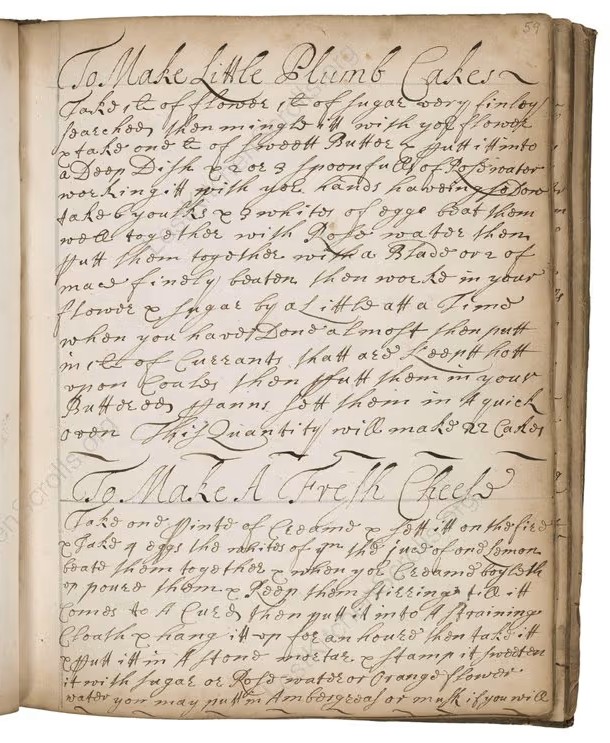
The original recipe reads: “Take ½ lb. of fine Sugar dry finley þarched, then mingle it with your flower & take ½ lb. of sweet Butter & putt it into a Deep Diſh & 2 or 3 spoonfulls of Roſe Water working it with your hands take ½ lb. of Currants & take 6 yoalks & 6 whites of egges Beat them well togather with Roſe water then putt them togather with a Blade or 2 of mace findly beaten, then work it in your Flower & sugar by a little att a Time when you have Done almost then putt in it ½ lb of Currants waſhed & dried & putt hott upon Coals, then putt them in your Butter’d pañns & sett them in a quick oven. This Quantity will make 22 Cakes.”
Like most late 17th-century recipes, the recipe is written as a narrative rather than with specific measurements or listed instructions. Ingredients are given in pounds and handfuls and any descriptions or guides are aimed at the experienced cook or housekeeper. Spelling was haphazard: ‘Finley þarched’ (for ‘finely parched’), ‘yoalks’ (yolks), ‘pañns’ (pans), and the archaic long ‘ſ’ (used in ‘Roſe Water’) pepper the text. Quantities were geared towards large households rather than a single family and with a practical order of ingredients – wet and dry ingredients blended in stages for a rich, sticky batter. The recipe was created at a time when domestic baking was starting to spread among English gentlewomen, blending tradition with the new luxuries of sugar and spice. However, ‘plum cakes’ were more like dense little sponge cakes containing either raisins and currants (‘plum’ being the general term for dried fruit) rather than the airier fruit cakes of today, but they were a signature of celebration and hospitality reflected in both the increasing availability and extravagance of imported sugar and dried fruit as well as the fashion for delicately-flavoured, perfumed pastries containing aromatics such as rosewater. Ann Smith herself was probably a woman of substance who had access to the ingredients and the staff or leisure time to produce these and other confections.
What sort of equipment might the late 17th century baker had access to? The answer is, perhaps slightly more sophisticated versions of the traditional, as well as their hands as the main tool for creaming and kneading! A large earthenware or wooden mixing bowl would be used to work the butter by hand; finely woven sieves for sifting flour and sugar; and a small whisk or fork for beating eggs. Currants were washed and dried, perhaps by an open fire and mace would be ground in a mortar and pestle. The cakes themselves would be baked in small round pans similar to modern-day tart or muffin tins, all buttered well to prevent sticking. The coals on the hearth provided ‘quick oven’, which would have been managed either in a brick oven or before a free-standing range, ash and embers carefully distributed for an even heat.
As I have mentioned, a more modern-day version of the original recipe is published on lostkitchenscrolls.org, and I referred to this when making these cakes but halved the quantities (using 115 g of butter and dry ingredients rather than 225 g) and spooned the batter in cupcake cases rather than just spooning it directly into muffin tin. However, I have further simplified the ingredients and method below for ease of use.
Metric Ingredients (makes approx. 22 or up to 12 if quantity is halved)
- 225 g (1/2 lb) caster sugar, plus extra for dusting if liked
- 225 g (1/2 lb) plain (all-purpose) white wheat flour
- 225 g (1/2 lb) softened, unsalted butter
- 2-3 tablespoons rosewater
- 6 large eggs
- A pinch (1/4 tsp) ground mace or nutmeg
- 225 g (1/2 lb) dried currants, raisins or sultanas
Method
- In a bowl, mix the sugar with the plain white wheat flour.
- In a separate bowl, soften the unsalted butter and work it well with your hands or a wooden spoon along with 2-3 tbsp rosewater until creamy and fragrant.
- In another bowl, beat 6 large eggs together with a splash more rosewater.
- Add a pinch of ground mace or nutmeg (a scant 1/4 tsp)
- Combine the egg mixture with the butter, then gradually fold in the flour and sugar mixture, step by step, until you have a loose batter.
- Towards the end of the whole mixing process, add the dried fruit and mix through.
- Leave the finished batter on the counter a short time to warm at room temperature, then spoon it directly into well-buttered muffin or tart tins, or alternatively line the tins with cupcake cases and spoon the batter into those.
- Tap the filled tins gently on the surface to level everything out.
- Bake the little cakes in a moderately hot oven (approx. 200oC/400oF/Gas Mark 6) until golden and fragrant.
- Leave the little plum cakes in their tins to cool for a few minutes before placing them on a wire rack to cool completely.
Bon appetit!
Catherine
What do you think of this recipe? Please let me know below!


Make a one-time donation
Make a monthly donation
Make a yearly donation
Choose an amount
Or enter a custom amount
Your contribution is appreciated.
Your contribution is appreciated.
Your contribution is appreciated.
DonateDonate monthlyDonate yearly Catherine Evans