• About

Catherine Evans

~ Creative Artist and Food & Lifestyle Blogger

Catherine Evans

Tag Archives: Healthy Living

Our Garden Project: July and August

Featured

Posted by catherineevans63 in Homegrown, Lifestyle

≈ Leave a comment

Tags

Berries, Carrots, Food, Fruit, Fruit and Vegetables, Gardening, Grow your own, Healthy Living, Herbs, Homegrown, Potatoes, Raspberries, Tomatoes, Vegetables

Early July started as June had ended with changeable weather. I was staying in Richmond-upon-Thames with my mother-in-law “MIL”, Verna, thus Dan was entirely in charge of the garden until he arrived to pick me up on the afternoon of 4th July. During my absence he had picked a few black raspberries that had ripened and some redcurrants, though the second batch of redcurrants we picked later on in July was a smaller one and sadly the whitecurrants amounted to nothing.

The Heritage beetroot were coming along well though their leaves were looking a little tatty but nothing a little plant food wouldn’t cure and they recovered well. By now in mid-August we have already picked a few; a few golden beet, a candy stripe, a white and a red one. A couple of them had been munched a little by slugs or snails but washed and with those bites chopped out they have been perfectly delicious chopped and lightly pickled in a drizzle of home-produced raw apple cider vinegar or grated salads, with their spinach-like leaves washed and shredded, added to salads and curries.

The “weed” potatoes have continued to flourish and earlier in July, Dan harvested some and we enjoyed these at mealtimes. Funnily enough, it looks like more of these plants are cropping up in other places in that bed so we may have a good potato harvest entirely by fluke!

The beans and peas produced a very small though delicious crop, despite being trampled on by our two adopted cats, Arthur and Miss Robyn Guinevere. Our senior boy, Merlin, appears to be more enlightened and leaves our crops alone though enjoys a wander or two in the garden and a rest on the patio most days; he was always more of a house cat in his nature.

Later in June of our elderly neighbours who lives further along the street had given us a courgette plant and some tomato plants and they had bedded in really well. We are growing a wide variety of tomatoes this year, from plum to salad varieties to cherry tomatoes perfect in salads or for snacking. Once I had returned from Richmond I stopped by for a chat and she invited me in to see her garden. She has a big birthday later this year yet shows no sign of discarding her green fingers, and her ability to be sustainable and grow all she needs is impressive. She has some really inventive methods of growing fruit and vegetables and not one area of her garden is an empty space but is well-utilized. I believe gardening helps to keep her positive and young at heart and she even has carefully thought-out areas for her beloved cat Monty to enjoy.

The blueberry plant is still young and there will be no crop this year, but it is thriving among the pine needles. The plant produced a single berry which we shared. It was full of flavour and we look forward to more next year.

The second crop of radishes failed miserably. They were flourishing in July and despite being thinned out, most failed to swell or develop. Perhaps it was the soil or the weather, or perhaps it was a combination of both. One reason for radishes not developing can be if the soil is too compact or if it contains excess nitrogen. The soil was loose enough and as we have usually grown radishes in the ground in previous years, we can only assume too much nitrogen was present in the soil and in future when growing radishes in containers we will add some mulch, which should help to rectify the problem.

The butterhead lettuces were a tasty success and were picked for salads during the course of July but the second batch of seeds did not produce the hoped-for rocket as we had a rainy spell towards the end of the month and the slugs and snails stripped the rocket and the underwhelming radishes bare, so all was lost, and the nasturtiums were looking glum though a few of those have rallied round after another plant feed.

Our Garden in July

The rhubarb has cropped amazingly well this year. We have picked rhubarb every month since May right up to about a week ago. Last year the crowns were new and it was important to leave them to settle in, so this year has been their first harvest. I have chopped a lot of the July and August rhubarb into 1″-2″ chunks and stored in a big bag in the freezer for future recipes, including pies and chutneys, so we can still enjoy it once summer is long gone.

We picked some of the Heritage beetroot and all of the speciality globe carrots, all of which were delicious. The beetroot crop comprises a wide variety of types; we have white, red, golden and candy stripe. They have been pickled, grated in salads and roasted as part of a main dish with other vegetables. It is now early September and I have cooked the last of what we had picked so it’s time to pull up some more! Stored correctly or preserved and pickled they should last us through the winter months.

In August I sowed some cut-and-grow salad leaves and some land cress. The land cress is all used up now, as are some of the fast-growing salad leaves, so I have sown some more leaves along with some spinach to keep us going for the next few weeks, as we eat salad for lunch every day.

Whilst making the August video we came across some wilded blackberries nestled among our redcurrant and black raspberry canes, a sheer delight! We love blackberries made into jam or in pies and crumbles, and they are also a good accompaniment to game, which Dan enjoys. We also enjoy them just as they are, freshly picked.

If you do not already grow any of your own produce, I hope our garden project has been inspiring you to give homegrown a try.The main thing to note is that home produce is of course at is freshest, can just be picked whenever it is needed and is way more flavourful than shop bought, which tends to be picked before it is ripe and is often stored or treated with chemicals or preservatives for a longer shelf life and therefore isn’t as fresh as homegrown or, say, foraged or purchased from a local farm shop for example. If you don’t object to finding pests in leaves and salad greens or having to wash the soil off your root vegetables, and if you have any amount of space to grow your own – even if it’s just a window box or a few plant pots or other containers – then I think homegrown is definitely the way to go.

Happy gardening!

C
Our Garden Project 2023: May and June

Featured

Posted by catherineevans63 in Homegrown, Lifestyle, Uncategorized

≈ 4 Comments

Tags

Berries, body, Food, Gardening, Healthy Eating, Healthy Living, Homegrown, Nutrition, Potatoes, Salad, Seasonal, Tomatoes, Vegetables

Spring was late this year, we estimate most things are 2-3 weeks behind in growing time and despite some obvious challenges, it has not deterred us.

Dan and I have grown our own produce ever since we had our first flat together in Isleworth 16 years ago, though I personally have been growing fruit and vegetables since the mid-1990s after I left my long-term partner at the time and moved into a rented house in South Derbyshire. The property had a garden with a greenhouse and a lawn, and a shared accessway with my neighbours in the small row of railway cottages we occupied.

I started off with tomatoes and bell peppers in the greenhouse and soon discovered I had ‘green fingers’ as the space became full and I would engage in exchange and barter schemes with a couple of my neighbours who had allotments across the road from the cottages. Those allotments were on fertile land by the canal and there was a long waiting list but in any case in those days I worked full-time and therefore did not have sufficient time to invest in a large growing project, but the seeds were sown and I had fallen in love with gardening and the whole ethos behind home-produced.

Over the winter months of 2022/23 in the midst of the global cost-of-living crisis and mindful of the need for tightening our money belts, Dan and I spent some time discussing and planning what we would grow this year in an effort to become even more sustainable and self-sufficient. Although we grew a variety of fruit and vegetables last year, we knew our garden was capable of accommodating more, even with one of our two raised beds being purposely left fallow for the whole growing season to allow the soil to regain its nutrients. The continuous growing of crops eventually depletes the soil of certain nutrients, resulting in the fall in crop yield. This means that manure or fertilizers need to be added to the soil in order to replenish it with the nutrients it has lost.

There are a number of disadvantages of adding fertilizers to soil. Expensive to buy, they they are easily washed away by water and reduce the fertility of the soil. Also, they harm the microbes naturally present in soil and cause pollution. In general, fertilizers provide only a short-term fix as they also tend to change the nature of the soil, making it either too acidic or too alkaline, although some plants may thrive in one or the other. For example, blueberries must grow in acid (ericaceous) soil or potting compost with a pH value of 4.5-5.5. Our blueberry plant is happy in a corner of our garden near our quince tree among a nest of pine needles.

Over winter I ordered four wooden self-assembly ‘growing tables’ (80 x 40 x 75 cm). Made from 100% FSC sustainably sourced wood, the design comprises a trough on legs for easy-working height with a shelf underneath, from Homebase and these cost around £37 each, although the price has since gone up to £45. These I had home-delivered and Dan put them together, two for our patio and two for our greenhouse. We then lined the troughs with black membrane and filled them with topsoil. Two have since collapsed due to warpage, and so far Dan has mended one of them and we have some plastic troughs on the patio containing various salad goodies. We store and thoroughly wash and reuse all our pots and other growing containers until they fall apart, so fortunately when the tables collapsed we had other containers ready to hold the plants that had endured a nasty shock.

My main project is tending the herb garden and the salad goodies while Dan focuses on the rhubarb, the soft fruit and the vegetables in the other raised bed which needs heavy digging and with my back problems is something I am not capable of, though I do help out from time to time.

We sowed and propagated a variety of lettuce and tomato seeds indoors throughout March as the weather was still too cold to sow directly into the raised bed or any container outside, and more seeds – jalapeno, salad leaves, bell peppers = were sown indoors in early April as the weather continued to be disappointing, but finally they were ready to go outside and by the time King Charles III was coronated nasturtiums, cut-and-come again salad leaves (which were ready for harvesting) and radishes in the growing tables, more lettuce seedlings in a trough and in the greenhouse tomato plants growing well and the salad leaves, chillis and peppers sown back in April propagating in egg boxes.

We use no chemical pesticides or other chemicals on our crops but to deter slugs and snails we scatter broken-up egg shells, oatmeal or sharp sand which act as a natural deterrent, although this method is by no means foolproof. It is however kinder to creatures and the environment and ultimately our digestive systems.

The kale seeds we had sown directly in the ground in March was flourishing. Although primarily intended to provide us with a good source of nutrients during the ‘hungry gap’ period of January and February next year, later in May we were able to harvest some of the young leaves to chop finely for salads. Next to be sown directly into the ground were carrots, parsnips and Heritage beetroot, beans and peas, which would provide a variety of colours and flavours during the summer.

Two or three ‘weed potato’ plants had sprung forth. These are plants that grew out of last year’s potato crop when we had probably overlooked a few potatoes in the ground during harvesting. This seems to happen most years and the potatoes are always delicious and perfectly formed with no blight or tunnelling. A happy accident, one might say.

In the herb garden we had garlic, lavender and rosemary all growing well in pots and there was rhubarb ready for picking.

The blueberry bush we bought last year was faring reasonably well though needed repotting, though of course in the end we planted it in the ground. The quince tree provided us with a good harvest last year and was once more coming into leaf after a long winter and the black raspberry bushes and redcurrants and whitecurrants were also flourishing although we did not expect a harvest until later in June or July due to a late spring so to celebrate the Coronation, Dan was perfectly happy with a dressed crab salad containing the first of our tender, homegrown salad leaves. You can see the recipe video here:-

The month of June started with similarly mixed weather and variable results, and certain of the salad goodies were not thriving as they ought, especially the radishes which were stunted in growth and spongy and eventually I pulled them up and sowed a fresh quantity of seeds in their place. The second of the growing tables also collapsed.

The butterhead lettuces I had planted were a delight and we enjoyed them in our daily salads along with some of the nasturtium flowers and leaves that were thriving; some of them were not so these too were pulled up to make way for fresh salad goodies.

The Heritage beetroot were also beginning to flourish and we started to look forward to the time (a bit later in the year) when they would be ready to pick perhaps for a colourful beetroot salad – red, candy stripe and golden – along with some soft goat’s cheese, its creamy saltiness balancing out the sweet earthiness of the beetroot, a union of perfection with a zingy red wine vinegar dressing dancing on the tongue.

Our rhubarb was still growing lavishly. We had started harvesting it in modest quantities since early May, simply picking as much as we needed, and this continued throughout June month. A poached rhubarb compote spiked with orange juice and root ginger and finished with a drizzle of honey was a simple and healthy pudding served with some full-fat Greek yoghurt.

The carrots, peas and beans were all coming up and the black raspberries were well on their way for picking, and we started harvesting at the end of June, along with the first of the redcurrants.

The young kale we had planted earlier in the year we thinned out in June to encourage abundant growth, and the tender leaves were chopped finely and added raw to salads. Kale is a nutrition superstar literally packed with goodies; vitamins A, B6, C, K, folate, fibre, carotenoids and manganese and you can eat it every day in moderation for a real boost to your health and wellbeing and a strong immune system. Believe it or not, one single, 100g serving of kale provides over 100% of your daily intake of vitamin C, which helps to reduce the risk of cataracts. Kale also provides a rich source of tlutein and zeaxanthin, antioxidants that lessen the risk of macular degeneration and other age-related eye diseases.

In the greenhouse the bell peppers and tomatoes were in good condition. We had started spraying the leaves every five weeks with half a soluble asprin added to water in a bottle (a tip I learned from watching “Countryfile”), which helps to protect against blight. Potato plants, roses and most other plants can also be sprayed in the same way to protect against diseases.

Thus, only the salad greens were conspicuous in their lacklustre, but I was resolute in my determination to succeed.

The garden in June 2023.

A New Year: Goals or Resolutions?

Featured

Posted by catherineevans63 in Food and Drink, Lifestyle, Music, Uncategorized

≈ Leave a comment

Tags

2023, Achievements, body, Chinese New Year, conversation, Diet and Exercise, Dieting, Dry January, Exercise, Facebook, Food, Gardening, Goals, Healthy Living, Healthy Regimes, Instagram, Life Skills, Music, New Year, New Year's Resolutions, Rumble, Social Media, Success, Veganuary, Vegetables, Video Content, Year of the Water Rabbit, YouTube

First of all, I would like to wish all my subscribers (and other readers of my blog) a very healthy, happy and empowering 2023. If you are new to my blog, welcome, and I do hope you enjoy reading my content.

I guess it’s true to say I’ve been gone a while; there’s been a lot happening the last few months; most notably juggling balls and spinning plates in the air (metaphorically-speaking), the whole festive thing with its gift-buying-and-wrapping, tree-buying and decorating and taking down again, cooking, washing and tidying up, making and editing videos for my various platforms, wading through mountains of admin and paperwork and accounts, doing my music, making and pricing up and photographing of items for my two pitches at the Petticoat Lane Emporium in Ramsgate plus my Etsy shop and my Ebay site (basically, doing what I can to earn some money whilst also running a household and helping my piano tuner husband to be a success in his trade), visiting nearest and dearest and those further away up and down the motorway . . . and looking after our two young cats and one diabetic, arthritic and incontinent senior tabby cat, our lovely loyal boy Merlin who follows me around or sits on his favourite chairs watching me with love hearts in his eyes. Merlin was diagnosed with diabetes in October of last year, following the suspicions I had carried around for a while, watching and observing his habits and demeanor. Several months had passed before Dan would believe me and when he did, he admitted he had been in denial. We have put a lot of work in with Merlin as it takes him time to adjust to change. We have had to change his mealtime regime to twice only daily – to which he was not at all receptive for several weeks – source wet food and biscuits for him that are diabetic friendly and made of the most natural ingredients (which of course are far more expensive than regular cat foods, but anything for our boy), inject him twice a day 30 minutes’ after he has finished eating, change his pee pad in his special tray sometimes multiple times a day and mop the floor, as he often dribbles urine when he’s finished his business. I sometimes cook him fresh chicken or turkey and he might get a little of this if he’s very hungry during the day and needs a small snack; the vet said it was better than giving him more biscuit. I also groom him regularly and massage extra virgin olive oil into his fur as he is prone to flaky skin. This he enjoys very much and likes to lick the oil on his fur. Twice we also give him a fish oil powder capsule which we break into his food and mix in well. This also helps to ease his skin condition though it seems to have made only slight improvement to his mobility.

He sees the vet once a month for a checkup, to get weighed, examined and bloods taken to monitor his insulin levels. This time we discussed his mobility problems which suddenly came on more recently and seem to affect his pelvis and back legs from what we can make out when we watch him move around awkwardly. The vet was very gentle with him when she examined him thoroughly and agreed that his hip joints appear to be arthritic and at one point we heard a ‘click’. She also said that the muscles in his back legs are weak, which of course is probably due to the fact that he is no longer to move about comfortably so the muscle is wasting. At home, he is no longer able to jump on to the side of the bathtub to drink from the cold running water from the washbasin tap, something he has enjoyed for most of his life; nor is he able any longer to run up the stairs when I call to him and instead he makes a slow hop up one stair at a time, which breaks my heart. One day last week he tried to jump up on to the kitchen chair beside me and was unable to do it, his claws caught in the fabric seating, so I picked him up gently and lifted him on to the seat though mostly he can still manage without help. It is, though, heartbreaking to see him in discomfort and unable to do some of the things he used to enjoy. The vet recommended a full panel of bloodwork this time to check that Merlin doesn’t have any underlying medical conditions other than the diabetes and to rule out anything else such as side effects from his insulin. If the results come back clear, we can perhaps start him on Metacam medication and see where we go from there, though she understands I prefer the natural way and she definitely thinks animal healing is a good idea and told me she used to work at a practice that encouraged it for their furry clients.

Anyway, I digress, since this is intended to be an article about goals and New Year’s resolutions. As we journey the days in the life of January, it is perhaps opportune to think about what we might all wish to achieve during the Chinese New Year of the Water Rabbit (ironically, in which I was born almost six decades ago, in 1963) when celebrations start on 22 January.

It is customary, as one year ends, to formulate our intentions for the coming year and this is often done at New Year’s Eve or it’s equivalent, for example the Pagan festival (Sabbat) of Samhain (Halloween) or, yes, at Chinese New Year. Whether we be adult or child, deciding to set ourselves a few tasks or objectives can be both life-affirming and empowering, however resolutions often fail because they are too vague and lack real focus. For example, a desire to “eat more healthily” or “take more exercise” is not specific enough, as neither address how you are going to eat healthier or how or what exercise you intend to do. However, if for example, you say: “I am going to grow and harvest my own salad greens” or “I am going to eat a salad at least five days a week and enjoy one glass of wine a week” or “I am going to go for a swim three times a week”, then those are specific goals. This is how New Year’s resolutions are more likely to be successful.

If living a more healthy lifestyle is on of your goals, perhaps you felt guided to give Veganuary and/or Dry January a try in order to kick-start the process and shift a few pounds after the excesses of the festive season. If, at the end of it you begin to feel the benefits of the initiative and find you are enjoying trying different foods and the creative aspect of preparing a healthy, balanced meal with fresh ingredients or can see the benefit of limiting an alcoholic drink to once a week then perhaps you might decide to make it part of your everyday life. On the other hand, if you tried it as an experiment and decided you missed some foods too much but you don’t mind cutting back on them a little in future and you did lose some weight and you learned more about yourself in the process then that’s good too. Everything in life is a learning process and one size does not fit all. Do not think either that you have failed if you despised most or every aspect of Veganuary/Dry January, you didn’t lose any weight or you just couldn’t ride it out right to the end; at least you gave it a try and know beyond doubt that what is right for one person is not necessarily right for another. We only fail if we think about doing something but don’t try it out at all.

I take on board that vague resolutions may work for some people, but personally I never found they worked well for me and I need the structure and clear intention that a solid goal gives me, something to aim for at which I can monitor my progress and at the same time stay positive and focused. It needs to be something that challenges my capabilities and mindset but at the same time is realistic and achievable. Here are a few of my goals:-

  • To grow my social media:-
    • Do at least one video per week for either my Rumble channel catevansartist or one of my three YouTube channels – @catevansartist, @catevanscuisine or @electrickwytchofficial.
    • To do at least one video a week for either my Facebook or Instagram on whatever topic feels appropriate
    • To do two Facebook or Instagram live streams per month
    • To upload a new blog at least twice per month
  • To drop one dress size this year by continuing my healthy regime. This includes going out for a walk or disco-dancing at home both at least three times a week. Also my newfound interest in sprouting seeds and fermenting, as well as continuing to eat a salad every day and by growing a wider range of organic salad greens in my back garden which I can pick what I need each day and when they are at their freshest. I have already made a start on this by purchasing four “growing tables” which are wide, wooden planters at table height with shelves below for storing compost – or even more planters containing healthful goodies, especially useful for tender plants which do not fare so well in full sunlight. I have called it “My Garden Project” and will be discussing more about this in a future blog post.
  • To focus more on my music by:-
    • Piano practice 5 times a week (often I manage four).
    • Composition/songwriting one half-day per week
    • Record the 4th movement of my sonata in preparation for the studio.

“How will you achieve all of this when you already lead such a busy life?” you may ask. As a self-confessed workaholic I take this on board and one of my tasks this year is to slow down a little and make more time by cutting back on activities that have the least importance. Non-negotiable are some household chores, seeing to the cats and meal preparation. Also, paperwork and general administration is vitally important; I do my husband’s as well as my own and failure to do paperwork will land us in a mess. Plus, at some stage it would need catching up on, resulting in a potentially stressful situation. However, I am able to free up a bit more time by the way I do it, for example spending an hour a day on paperwork and admin rather than, say, two or three hours twice a week. I am also able to fix crafting activity to maybe one morning or afternoon a week. I still have outlets and online to produce items for but I have fewer of them now and no longer need to hold larger quantities of stock and can therefore produce just as much or little as I need, which also increases efficiency and turnaround. I am also an avid maker of ‘to-do’ lists and have been using these more as an exercise to see exactly what I can achieve without filling up every second of my day, as being kind to ourselves and having sufficient rest and recreation time does help with focus and productivity. I can comfortably complete four or five tasks a day but if I complete any quickly or if I choose to push myself I can manage half a dozen. I am no longer minded to tackle more than that.

Neither do I need to concentrate on all goals at once. Some goals may be ongoing, others may be achieved quickly or may not work out as planned or may need to be ‘tweaked’, or put on hold, and new ones may present themselves instead. We should remember that personal and business circumstances may change either suddenly or over time and these circumstances may have a knock-on effect on what we are able to achieve. The point is, sometimes goals take longer to achieve even if we have put in some good work, but as long as the foundations and groundwork are there they can be picked up again in the future, by which time we may have more wisdom of experience and learning that will help bring our goals to fruition in a more effective way. As long as we enjoy doing what we are doing and gradually see some results or learn more about ourselves and our aspirations in the process it’s all good. If we don’t enjoy doing what we are doing, then perhaps we might find something else to try that might work better. We are all a work in progress and there is no need to beat ourselves up about it if something isn’t quite working out. Even taking a little time out might revive and refresh our vigour.

What are your goals in 2023? Is there anything that is going particularly well for you? Is there something you are struggling with or does not inspire you? I would be interested to know, as sometimes by sharing our experiences we might learn from one another.

Happy NEW Year!

Please tip me a herbal tea!Submitting form

Catherine.

A Healthy Winter Salad

29 Tuesday Nov 2022

Posted by catherineevans63 in Food and Drink

≈ Leave a comment

Tags

Antioxidants, conversation, Fermenting, Food, Gut Health, Health foods, Healthy, Healthy Bacteria, Healthy Eating, Healthy Living, Homemade salad dressing, Immune system, Probiotics, Recipe, Salad, Vegetables

Salad vegetables at any time of year are a good source of insoluble fibre, which helps you to maintain a healthy digestive tract and reduce LDL, or bad, cholesterol. By adding nuts, seeds or beans (maybe even some pea shoots or alfafa sprouts) to your salads you will also get a boost of soluble fibre which helps to lower cholesterol and keep blood sugar well-balanced, which is particularly important for diabetics and more generally to control mood swings, irritability, depression and cravings for sugary things. Other symptoms of blood sugar imbalance include fatigue, difficulty concentrating, feeling hungry after only a few hours of eating, blurred vision and fat storage around the midriff. These are also symptoms of clinical hypoglycaemia which is when blood sugar falls below below 55 mg/dL. Salad vegetables contain high levels of water providing our bodies with hydration necessary for youthful skin tone and various basic bodily functions such as urination and bowel movement.

Submitting form

Salads are so easy to prepare at home and a salad a day provides multiple health benefits at any time of the year. The main difference of course is that the various salad vegetables have their seasons, which is when they will be at their most nutritious especially if they are organic or homegrown and free from chemicals and pesticides rather than flown in from hundreds or even thousands of miles away, although even these will have some nutritional value and not everyone is able to afford to buy organic or grow their own produce, Please remember to rinse all your vegetables thoroughly in clean, cold running water before preparing in order to get rid of any grit, soil and pests or residue of chemicals and pesticides.

One of the best things to include in your salad is leafy greens rich in Vitamin K such as baby spinach, Romaine lettuce or watercress in the summer and shredded kale in the winter. Low levels of Vitamin K have been linked to low bone density in women and just one cup of leafy greens per day will promote bone growth and improve the performance of the mitochondria which are the tiny cell structures that help us produce energy and effective muscle maintenance and growth. Romaine lettuce in particular contains significant levels of folate which helps to prevent stroke and cardiovascular disease. Grated or fine julienne strips of carrot, beetroot and celeriac and some finely shredded red cabbage also pep up your winter salad and help to make it super nutritious. Aim to make your salads as colourful as possible to maximise your intake of vitamins and minerals and to increase the level of powerful antioxidants in your blood. “Red” fruits and vegetables such as tomatoes, red and orange peppers, carrots, stone fruits like peaches and apricots and berries such as blueberries, pomegranates and cranberries are of particular nutritional benefit as they contain carotenoids such as Vitamin A, beta-carotene, lycopene, lutein and zeaxanthin as well as providing the body with antioxidant and anti-inflammatory attributes. Carotenoids – which are also found in the green leafy salad vegetables – also help the eyes to adjust between light and dark and to filter out high intensity light levels and thus protecting the eyes from the formation of damaging free radicals.

A fibre-rich salad will help you feel full faster so you will consume less calories than you might otherwise and including as many raw vegetables as possible will maximise their positive effects. If you can, try incorporating a handful of chopped nuts or seeds in your salad and a homemade salad dressing provide a good source of healthy oils, as does adding some sliced avocado which enables the body to absorb all the protective compounds, lutein and phytochemicals it needs for optimal health and wellbeing and a strong immune system. Nuts and seeds are also a good source of zinc and selenium, which help to prevent heart disease and develop antibodies in the immunocompromised, improve metabolism and thyroid function. Selenium also contains antioxidants that help to boost male fertility by increasing the sperm’s mobility to help it to swim and fertilise the ova. Zinc helps to keep white blood cells healthy to fight disease and infection, enable wound healing and encourage cell production in the body. A paper published in 2003 in the Folia Microbiologica noted that zinc and selenium are both important in modulating immune function and selenium in particular is necessary for the functioning of three different types of immune cells – neutrophils (they comprise 40% of white blood cells and 60% of the immune cells in the blood), macrophages (they help to eliminate foreign substances and microorganisms and other harmful organisms by overwhelming them and triggering an immune response) and ‘natural killer’ (NK) cells (lymphocites, which belong to the ‘B’ and ‘T’ cell family but respond quickly to a whole host of pathological challenges such as killing virally infected cells and detecting and controlling early signs of cancer).

One-Time
Monthly
Yearly

Make a one-time donation

Make a monthly donation

Make a yearly donation

Choose an amount

¤5.00
¤15.00
¤100.00
¤5.00
¤15.00
¤100.00
¤5.00
¤15.00
¤100.00

Or enter a custom amount

¤

Your contribution is appreciated.

Your contribution is appreciated.

Your contribution is appreciated.

DonateDonate monthlyDonate yearly

TIP: Try making your own salad dressing. To a small jar add 6 tsp extra virgin olive oil, 3 teaspoons of raw apple cider vinegar, 3 tsp honey, 3 tsp Dijon or wholegrain mustard, season with salt or pepper, screw the lid on and shake thoroughly to combine. Depending on what salad you are making you might also like to add a squeeze of fresh lemon, lime or orange juice and this kind of salad dressing also stops fruits such as chopped avocado and apple from browning. Also try adding antioxidant-rich chopped herbs to your dressings and salads such as coriander, thyme, dill, garlic, chives, rosemary and mint (which pairs particularly well with apple) to bring a further dimension to your plate.

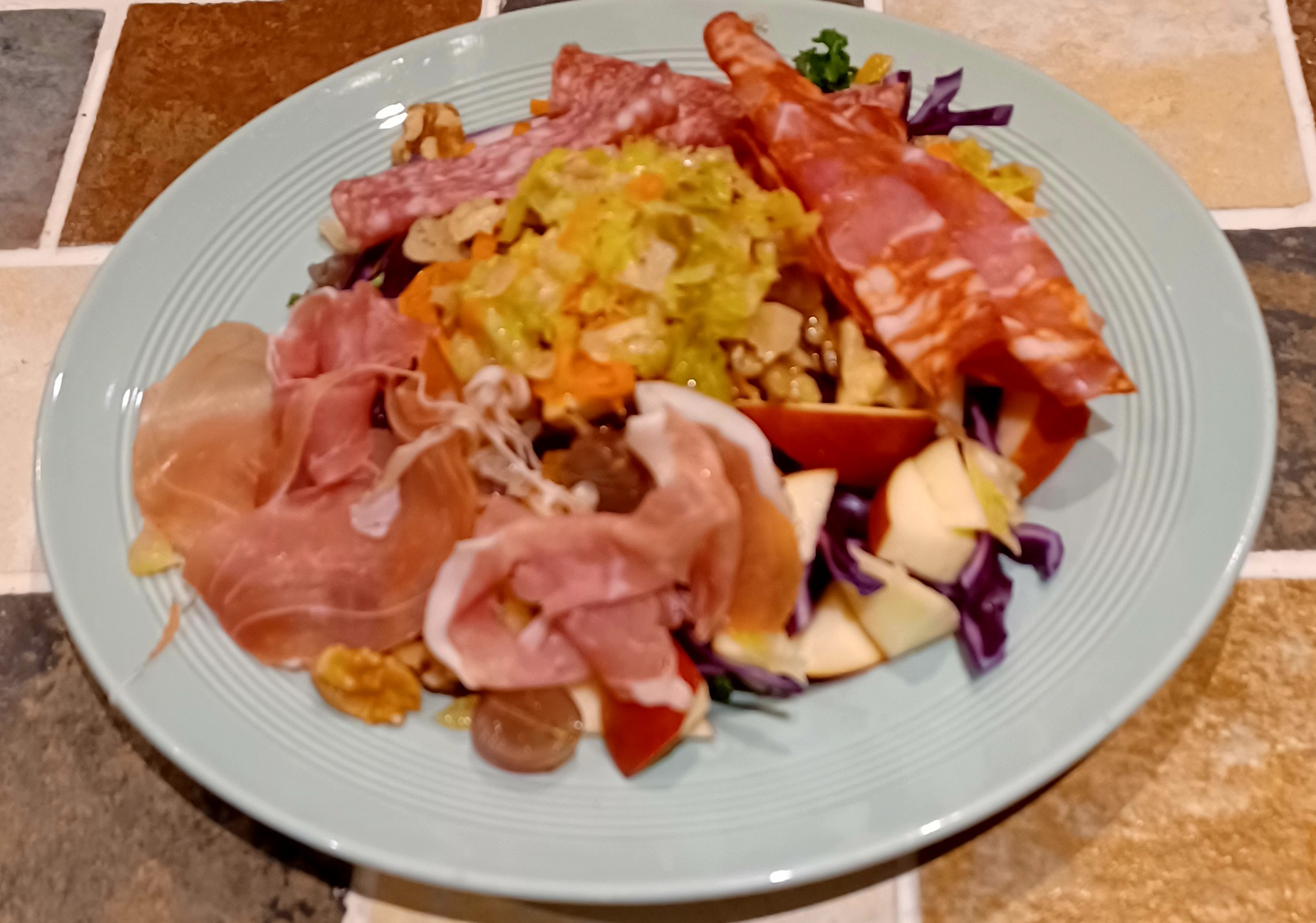
Below is a basic winter salad using some of the fresh raw seasonal fruit and vegetables that Dan and I had bought from our local farm shop at the weekend or had delivered from Riverford Organic. I dressed the salad with my basic homemade salad dressing (as detailed in the above paragraph), adding a dollop or two of home-fermented cabbage with its health-giving probiotics and a handful each of walnuts and mixed seeds for a bit of crunch. Quantities are random – it is entirely up to you how large you want your salad to be or for how many people you are catering – but this one will feed two.

Ingredients

  • A wedge of red cabbage, thinly shredded
  • A good handful of organic curly kale, thinly shredded
  • Organic carrot, sliced into thin julienne strips
  • Large stick of celery, chopped
  • 2 small local apples, cored and chopped
  • handful of organic black grapes, halved
  • Handful of walnuts, roughly chopped
  • Handful of mixed seeds
  • Two tablespoons of fermented cabbage (optional) – my homemade one is fermented with grated carrot and cumin seeds.
  • Salad dressing

1. Wash and prepare the fruits and salad vegetables and place in a large bowl.

2. Add the roughly chopped walnuts, drizzle in the salad dressing and mix into the salad to combine thoroughly.

3. Pile the salad into the middle of one platter or two large plates.

4. Spoon the fermented cabbage (if using) on to the bed of salad and sprinkle with mixed seeds.

COOK’S TIPS:-

This salad is vegan if served on its own or with sliced avocado or some falafels.

This main course salad can also be served with shaved parmesan or vegetarian substitute, some hot smoked mackerel or salmon or even charcuterie. However you choose to present your salad, it is very versatile!

Dan had Italian charcuterie with his salad!

Buon appetito!

Catherine

Donate with PayPal

Blog at WordPress.com.

Privacy & Cookies: This site uses cookies. By continuing to use this website, you agree to their use.
To find out more, including how to control cookies, see here: Cookie Policy
  • Subscribe Subscribed
    • Catherine Evans
    • Join 42 other subscribers
    • Already have a WordPress.com account? Log in now.
    • Catherine Evans
    • Subscribe Subscribed
    • Sign up
    • Log in
    • Report this content
    • View site in Reader
    • Manage subscriptions
    • Collapse this bar
 

Loading Comments...