PRINCES AND PRESIDENTS

Tags

, , , , , , , , ,

On Monday 3 January 2022 the Jeffrey Epstein papers were unsealed and made public in a ruling by United States judges. The sealed financial settlement of $500,000 was made in 2009 between the disgraced financier and Ms Virginia Giuffre (formerly Roberts), a sex trafficking victim of Epstein who has launched a civil lawsuit in the US against Prince Andrew for sexual assault. Ms Giuffre claims she was forced to have sex  with the Prince at Ms Maxwell’s London home when she was a 17-year-old minor, but Prince Andrew denies the accusation and insists he was at home on the evening of the alleged assault. He claims that he had taken his daughter Princess Beatrice to a Pizza Express for a birthday meal in Woking at around 4 or 5 o’clock that afternoon and as his loyal ex-wife Sarah Ferguson was away from the family home that day, the rule they always had was that he would spend the evening at home with their two girls, although as yet he is unable to prove any of this. Nor, despite photographic evidence to the contrary, does the Prince recall having ever met Ms Giuffre.

Ms Giuffre alleges that Prince Andrew abused her in 2001 on 3 separate occasions when was 17 years old and known as Virginia Roberts. She claims the first time was in Ghislaine Maxwell’s London property, the second time in Jeffrey Epstein’s townhouse in Manhattan and once on his Little Saint James Island estate (also known as Epstein Island). She filed her lawsuit against Prince Andrew in August 2021 in the Southern District Court of New York under the New York State’s Child Victims Act.

The Prince’s lawyer, Andrew Brettler,  described Ms Giuffre’s case as “baseless”, also stating that it was “ambiguous at best and unintelligible at worst”. Last weekend he also attempted to have the case thrown out, arguing that Ms Giuffre, who is a US citizen, now lives in Australia with her husband and children but evidence showed that she is domiciled in Colorado and is registered to vote there, and New York Judge Lewis Kaplan rejected a dismissal. In any case, Australia is enduring draconian restrictions under governmental coronavirus policy many people are not even permitted to cross state borders, let alone fly in and out of the country unless for specific, authorized reasons so even if Ms Giuffre had fully intended to return to Colorado at some point she may have been unable to unless granted special dispensation.

Back in 2019 Prince Andrew appeared in an ill-advised, ‘car-crash’ television interview with the BBC journalist Emily Maitlis in an effort to clear his name, in which in a BBC article earlier this week she said the answers he gave to her on camera in response to the allegations made against him by Virginia Giuffre may have seemed “astonishing”, maybe even “jaw dropping in places” but that in some strange way she had been expecting them. Before the cameras rolled the two had talked through the things he wanted to say part of her job was to create the space for him to speak and explain on the record his own account of what had or had not occurred, and in no way was the interview intended to “catch him out”. She said that having watched back at the interview and the questions she asked that day she was taken back at their directness but she had simply gone with the flow as it was the only opportunity to hear the Prince’s side of the story. During the interview Prince Andrew denied he had ever slept with Ms Giuffre; he was in Woking at a Pizza Express with his daughter Beatrice in the late afternoon of the day of the alleged offence. He also denied Ms Giuffre’s claim that he was sweating profusely at Tramp nightclub whilst dancing with her just hours before the alleged abuse took place, owing to an “overdose of adrenaline in the Falklands War” which had left him unable to perspire. However,  it has since been reported that Prince Andrew’s lawyers have so far been unable to provide any documentary evidence that he is unable to sweat, despite his strongest denial of the allegations made against him.

Discussing the case over dinner with a friend the other day, they pointed out to me that often the Royals tend to possess a certain naivety, relying on aides and Palace officials for advice on day-to-day as well as more important issues, though ultimately the Royal member will make the final decision and can choose to avoid any counselling given. For example, with this in mind and despite his haughty and entitled attitude Prince Andrew may simply possess a poor filter when it comes to friends and associates and perhaps he had been manipulated (and flattered) by his dazzlingly charismatic, well-connected and worldly friend Ms Maxwell, who played him like a fiddle and coaxed him into her web of deceit with her lively spirit and warm-hearted generosity, however disingenuous she actually was; that in his naivety he was hoodwinked or ‘framed’ into posing for a staged photograph with his accuser (and Ms Maxwell smiling in the background) that might prove useful in the future and implicate him in her deeds should her means demand it. If this argument is a valid one, then it might be argued that the same goes for Ms Giuffre herself, however there is nothing to suggest she has not spoken her honest truths and surely if there had been a shred of doubt regarding her story she would not have been awarded compensation from the Epstein settlement fund. One might also argue that even assuming Prince Andrew DID visit Epstein Island, it is possible he stayed at a guest house on the estate and not at the main house and therefore was blissfully unaware of what was going on, but again the burden of proof would lie with he and his legal team and would they be in a position to prove it beyond a reasonable doubt?

On Tuesday morning following the unsealing of the Epstein settlement,  a hearing took place between Judge Kaplan and the legal representatives for the Plaintiff and the Defendant. Andrew Brettler on behalf of Prince Andrew argued that Ms Giuffre had accepted a $500,000 financial settlement from Jeffrey Epstein and that one of the conditions contained therein stipulated that she not pursue a case against any associate of Epstein, therefore shielding Price Andrew from her new lawsuit. He argued that Jeffrey Epstein would never have wanted his name dragged back into a lawsuit where Ms Giuffre might later sue Prince Andrew and others and then subpoena Epstein to attest.  However, Judge Kaplan highlighted the very broad scope of the settlement including the language applied to “other potential defendants” which left it open to interpretation and pushed back against Brettler’s argument.

Neither was Judge Kaplan interested in Brettler’s demands that Ms Giuffre share further details about the alleged events that had taken place and told him point blank that “it’s not going to happen”. He did say that Prince Andrew had the right to dissect Virginia Giuffre’s allegations when both parties soon start sharing evidence.

Matters became very awkward at one point when Judge Kaplan quoted a specific sentence from Giuffre’s lawsuit. This line mentioned Prince Andrew sexually abusing the Plaintiff, Ms Giuffre, at Maxwell’s London home on one occasion during which encounter Epstein, Maxwell and Prince Andrew forced the Plaintiff to engage in sexual intercourse with Prince Andrew “against her will”. Furthermore, the Judge said that he must “assume the truth of the allegation” at this stage of the process. Mr Brettler retorted that the allegation was too vague, but Judge Kaplan struck back: “it was sexual intercourse. Involuntary sexual intercourse. There isn’t any doubt about what that means.”

David Boies, the attorney for Virginia Giuffre, said he intended to depose between 10 and 12 people including family members such as Prince Andrew’s daughter Princess Beatrice, his niece-in-law Meghan Markle, and his ex-wife Sarah Ferguson among others to give evidence, but would not depose the Queen out of respect. The Prince had insisted he was enjoying a pizza with Beatrice and therefore couldn’t possibly have gone to any nightclub with Virginia, and this would need to be proved and supported by his own family; Sarah Ferguson has consistently stated that she stands by her ex-husband “one hundred percent” and that they are still “living their love story”.

After hearing both sides, Judge Kaplan said he would make a decision as soon as possible, although it is widely believed he will allow this to go to trial and had said previously that he wanted to see one happen later this year. This will probably be sometime in the autumn.

Whilst an individual is presumed innocent unless proven guilty, the tactical strategies of the Prince and his legal team to derail any lawsuit seem to do more to arouse suspicion than defend his innocence. Quite aside from the arguments raised with Judge Kaplan in order to have Ms Giuffre’s case dismissed, it was reported later last summer that Prince Andrew flitted from Royal residence to Royal residence in an attempt to avoid court papers being served upon him. According to David Boies, on 27 August 2021 the court documents were handed to an on-duty Metropolitan Police Officer at the main gates of Prince Andrew’s home in Windsor Great Park, Buckinghamshire. The law firm Blackfords, who represent the Prince in “certain UK matters” questioned whether the papers had indeed been properly served and suggested they might challenge the court’s jurisdiction in the case, according to the Prince’s rights, including on the basis of potentially defective service. However, in court documents Ms Giuffre’s attorney, David Boies, considered it implausible that the Prince was unaware of the lawsuit and indeed that lawyers at Blackfords had been instructed by the Prince to evade and contest service and that they had confirmed that Prince Andrew had already had notice of the lawsuit and was weighing up his chances of success. Boies further argued that any other conclusion would be somewhat far-fetched, regardless of whether or not Blackfords confirmed service, as reliable media outlets all over the world had reported on the filing of the plaintiff’s suit, and countless articles about it had been published.

For us to get to the truth and for his own sake, Prince Andrew needs to fully cooperate and respond to the allegations made against him in an appropriate setting with the full intention of clearing his name if he has done no wrong. Surely he owes it to himself to set the record straight with the evidence required to prove his innocence once and for all. Time once spent at the centre of Royal life with a full diary of official and social engagements is now reduced to hiding behind the high walls of various of his mother’s properties and idling his days away in front of the television or helping his adoring ex-wife about the house with her charity work and with only his memories for comfort. A life so reduced is no life at all and in a way he has already created his own prison, wrapped in his self-serving cloak of humiliation and cowardice, choosing to bury his head in the sand in the hope it will all go away. On the other hand, facing the humiliation of being dragged through the Federal courts and exposed to innumerable sordid headlines, he may not feel is an option given his new desire for modesty and discretion and the fact that any trial might bring further disgrace to the Royal Family.

Daily Mirror Royal Editor Russell Myers has been reported as saying that the Palace will be nervous that any trial might overshadow the Queen’s Platinum Jubilee celebrations as she marks 70 years on the throne with a four-day weekend in June involving street parties, a gala concert at Buckingham Concert and a Jubilee Pageant, but Prince Andrew will not be allowed anywhere near the festivities and any outings.

Already aware that he would be banished from his mother’s Platinum Jubilee celebrations as well as any appearance on the Royal balcony,  to add to his woes The Daily Mail reported that the Metropolitan Police is under pressure from legal experts to question the Prince as it is learned that he and his friend Ghislaine had continued to socialize ‘for years’ despite her paedophile billionaire ex-partner Jeffrey Epstein’s conviction and was even the guest of honour at her birthday party at London’s Dorchester Hotel in December 2012. Former officers and prosecutors argue that the Met should investigate all the alleged offences committed on British soil ‘without fear or favour’. In other words, even Princes and Presidents should not be above scrutiny. The Met has maintained it continues to ‘liaise with other law enforcement agencies who lead the investigation into matters related to Jeffrey Epstein”, such as the FBI, but legal experts argue that the Met can no longer evade commencing an investigation; indeed it could be argued that it is their moral, ethical and public duty to do so. Prince Andrew has been quoted on many occasions as saying that he has offered to co-operate with the inquiry by the FBI who wanted to talk to him, but the US Attorney’s Office for the Southern District of New York had been unable to make contact with him despite their best efforts.

Seemingly his consistently (and what might be regarded as) irrational and obstructive behaviour and the outcome of the Maxwell trial have put Prince Andrew further under the spotlight. On the late afternoon of Wednesday 29 December 2021 Prince Andrew’s long-time friend, the British socialite Ghislaine Maxwell, was found guilty of recruiting and grooming teenage girls for sexual encounters between 1994 and 2004 with herself and Epstein on 5 out of 6 indictments at the Federal Court House in New York before Judge Alison Nathan. The moment happened quickly and almost unexpectedly  – though was, I am sure – a relief, being barely 10 minutes before the end of the session that day. Justice was finally served and the women whose lives were destroyed by years of abuse by Maxwell and her late partner-in-crime Jeffrey Epstein were vindicated. The twelve-strong jury had taken some 5 days to deliberate and due to the ongoing surge in Omicron cases, Judge Nathan had told the jury that if necessary they should reconvene each day throughout the customary new year recess until their verdicts had been reached. As each day passed and court house staff continued to deplete due to Covid, the situation was becoming increasingly risky with the strong likelihood of any juror testing positive as the days went on, which would end in a mistrial and this was the last thing Judge Nathan would have wanted. When the moment came, the press were ushered from the building and only 17 people were present to hear the verdicts. These included Judge Alison Nathan, various FBI agents, attorneys, the Defendant Ms Maxwell and a few dedicated writers who had tirelessly risen every day before dawn to stand in line for several hours in the freezing cold outside the court house to gain admittance, listened and observed intently in the court room and waited around every single day of the deliberations, sharing news and updates through their social media feeds and sub-stacks. These were mostly well-known writers and reporters: lawyer, journalist and author Lucia Osborne-Crowley; entrepreneur Jessica Reed-Kraus; and Vicky Ward journalist, bestselling author and host/reporter of the documentary “Chasing Ghislaine” – but also the Broadway and television actor, Leslie Rodriguez Kritzer, who took up covering trials and other subjects that interested her during the course of the pandemic and has dazzled many of us with her daily rhetorical updates, critical thinking and attention to detail throughout this landmark trial. Live streamed conversations between these four women also helped to bring the trial, and its aftermath, to life.

These writers observed that Ms Maxwell had been touchy-feely throughout the trial, dressed stylishly and sauntering into the courtroom each day smiling, kissing and hugging her family and her lawyers as though playing to an audience, note-scribbling and sketching back at the wonderfully experienced artists who had been selected to illustrate the trial in chalk pastels, these talented people who worked quickly in chalk pastels turning out 5 or 6 accurate sketches on a daily basis, until perhaps their fingers were raw and bleeding. However, whilst it might be assumed the Defendant would demonstrate some kind of human reaction to the verdicts and the prospect of a 65-year jail sentence, it was observed that she showed not a glimmer of emotion as she was led away to her holding cell; no kisses or smiles or hugs on this occasion for her siblings or her Defence team, more of an arrogant strop at the very notion that she should be found guilty as charged!

Evidently this entitled, arrogant and sociopathic woman did not expect a guilty verdicts and was confident that she would be acquitted, still believing that she was entirely innocent. How wrong she was and what terrific justice for all those women who were groomed and abused as young women and minors over a number of years, and who were represented by US Attorney Lisa Bloom, herself a former victim of abuse. Some of these women who had been abused and had already received financial out-of-court settlements from the Epstein Victim Compensation Fund took the stand under oath and were cross-examined, although Virginia Roberts Giuffre was not one of them and Prince Andrew’s name was not mentioned. However, during the course of the trial Ms Giuffre’s name was mentioned some 250 times and photos of her as a teenager were shown to the jury. Maxwell’s senior counsel Bobbi Sternheim and her colleagues including  Laura Menninger attempted to pick holes and discrepancies in the women’s testimonies. For example, the  $2.9m (£2.15m) that “Jane” had received from the Epstein Victim Compensation Fund was raised, together with a long-winded examination of her career as a soap actress with roles as a prostitute, cancer survivor and a woman who quashes a Mexican drug cartel, and she was accused of being “melodramatic”. Other witnesses stepped forward and partly corroborated her story, and by the time the second accuser, “Kate”, gave her evidence Prosecution were on-point with their questioning and the stories of her battles with drugs and alcohol and her reasons why she had continued to associate with Epstein well into her thirties took the wind out of the sails of any cross-examination from Sternheim. However, it was the harrowing and shocking stories of the third accuser, “Carolyn”, and the fourth, Annie Farmer, who added weight to the authenticities and similarities of the four accusers and again the Prosecution were able to ask the difficult questions before the Defence had the opportunity as the accusers were able to explain themselves in a non-hostile space.

The trial had been listed to last for up to 6 weeks, so it came as something of a surprise when the Prosecution rested its case at the end of the second week. Almost immediately stories appeared in the mainstream media that the Defence would be calling up to 35 witnesses to corroborate Maxwell’s version of events,  but following a three-day recess the Defence put on a chaotic performance sometimes struggling to call any witnesses. Three potential witnesses were banned by Judge Alison Nathan from giving evidence under a pseudonym and another, a British man named Alexander Hamilton, had Covid. On behalf of the Defence Laura Menninger begged Judge Nathan for a delay so they could bring forward the 81-year-old owner of the Nag’s Head public house in London’s Belgravia, to testify whether indeed Maxwell had owned a house in 1994 where allegedly Kate’s abuse had begun, but Judge Nathan denied the request.

On day 12 and supported by Sternheim’s arm behind her back, Maxwell stood defiantly before Judge Nathan and when asked if she wished to testify, instead of the customary “yes” or “no, your honour” she replied: “Your honour, the government has not proved its case beyond a reasonable doubt so there is no need for me to testify.” In summing up, Maxwell’s attorneys suggested that the four accusers who had testified against Maxwell had their memories manipulated over the passage of time, therefore wrongfully implicating her in Jeffrey Epstein’s sickening crimes but the writing was on the wall.

As spectators and members of the press waited in the bitter cold outside the court house last Wednesday evening, Maxwell’s family members and her lead Defence Attorney, Bobbi Sternheim, exited the building and gave a short statement, vowing to appeal the five guilty verdicts on sex trafficking and conspiracy indictments, however they face an uphill struggle against the overwhelming evidence upon which the jury voted ‘beyond a shadow of all reasonable doubt’.

For example, the challenges by the Defence might include focusing on the anonymous witnesses that Judge Nathan did not allow to testify, as well as the ruling that prevented them from recalling two of Ms Maxwell’s accusers. For the appeal to succeed Ms Maxwell’s legal team would need to demonstrate that Judge Nathan abused her discretion or violated rules of evidence. My personal view is that given that Judge Nathan has enjoyed a long and distinguished legal career (she has served as a judge on the US District Court for the Southern District of New York since 2011 and before that was engaged in private practice, academia and government service) and was nominated to the United States Court of Appeal for the Second Circuit in November last year by President Joe Biden, it seems highly unlikely that such challenge would bear fruit especially given that Judge Nathan was extremely mindful to seat an impartial jury, she was respectful at all times towards both sides, and Ms Maxwell received a fair trial. Furthermore, whilst there is a precedent for witnesses of sexual crimes to have their names removed, there is no precedent for the Defence to request that their witnesses testify under a pseudonym,  which is probably why Judge Nathan did not allow it. The Defence might also try to argue that the jurors felt rushed in reaching their decision due to the pressures of Covid, however Judge Nathan still openly told them to take all the time they needed and the fact that they returned a not guilty verdict on one charge showed that they had examined every shred of evidence during their deliberations and even if they believed that Ms Maxwell was guilty of the second indictment, if they were not absolutely certain beyond a shadow of reasonable doubt that she was indeed guilty then they would need to return a not guilty verdict on that particular charge, which is what they did. Ms Maxwell’s attorneys might also try to question the sums awarded to the four witnesses of up to $5m and call forward trustees of the Epstein Victims Compensation Fund which has paid out nearly $125m to some 150 individuals, in an attempt to highlight any inconsistencies in their testimonies to the jury. However, even if an appeal was allowed to proceed the Defence would need to demonstrate that any violations bore any weight upon the outcome of the trial.

As Ms Maxwell whiles away her time on ‘suicide watch’ awaiting sentencing in solitary confinement ‘next to a sewer’ in her prison cell, the FBI rifle through her notorious “little black book”, their eyes scanning the identities of the 300 or so names allegedly contained therein. Aside from Prince Andrew, who else is implicated in all of this? What do they know, what role did they play in it and what other scandalous deeds are hidden from view? Why would Prince Andrew and others not want to fight to clear their names instead of flying under the radar and evading justice? Is Prince Andrew not confident of his truths, his legal team or the loved ones who continue to support him, and is he indeed guilty of misdemeanors, notwithstanding he has clearly demonstrated poor judgement of character? Who and what are Prince Andrew and his friend Ghislaine Maxwell protecting that they keep protesting their own innocence and why should either of them think that they are above the law and the deeds of others? If Ms Maxwell’s appeal falters will she finally start naming names, resigning herself to the fact that whether she tries to get her sentence reduced or face whatever fate lies ahead in jail there is no way out? Her ex-lover Jeffrey Epstein was also put on suicide watch in jail and that ended badly; thoughts of that must surely enter her mind.

If after his deliberations Judge Kaplan allows the civil lawsuit by Virginia Roberts Giuffre’s against Prince Andrew to go ahead and if the Prince does not succeed in clearing his name – or even, as is now being reported, if he seeks to cut a deal to avoid further embarrassment to the British Royal Family – what names and deeds will begin to seep like a bloodstain through the pages of that Little Black Book in the coming weeks and months? According to karmic law, what goes around comes around and in the wake of trials and tribulations, stories and testimonies, the truth always wins in the end.

One-Time
Monthly
Yearly

Make a one-time donation

Make a monthly donation

Make a yearly donation

Choose an amount

£3.00
£9.00
£60.00
£3.00
£9.00
£60.00
£3.00
£9.00
£60.00

Or enter a custom amount

£

Your contribution is appreciated.

Your contribution is appreciated.

Your contribution is appreciated.

DonateDonate monthlyDonate yearly

Avenue Waltz

Tags

, , , , , , , ,

Although most of you know me for my recipe blogs, there is much more to me than just a love of food.

One of the other things I love is music. I am a published poet, songwriter and recording artist (as one half of the alternative due, ElectrickWytch, along with my husband Dan) and I also compose classical music, notating by hand.

Writing music score is an activity I started more recently, over a four-day period during the last festive season on the run up to the UK’s Third Lockdown. Like many people in the UK, we had a quiet Christmas being joined only by Dan’s mum, Verna, who was in our ‘bubble’.

I play the piano and have been having lessons with my teacher Jake for about three years now. I really enjoy my lessons and although I had already been able to read music and play instruments off and on since a young age, my sight-reading has definitely improved over the last few years, especially since the Lockdowns when I was forced to teach myself the Grade 2/3 syllabus (I don’t get on well with Zoom or other online methods of learning and participation, I don’t feel sufficiently ‘connected’) and my forays into writing music. Regular piano lessons have enabled my skills and confidence to grow; although I have been writing songs for many years, never did I think that one day I would be able to start writing classical music and take to it like a duck to water.

My MIL went back to Richmond on 28 December and Dan, who is a Piano Tuner/Technician, had tunings in the London area that day. I had been amusing myself with daily piano practice and, with some kind of melody that had literally popped into my head very early that morning, I set about carefully writing the notes in pencil on to some blank manuscript paper that I found among my bunch of sheet music books. Over the next few days, I wrote the music in small sections at a time, going between the paper and the piano as I expanded and built up the piece. I recorded certain sections of the piece on to my mobile phone to help me recall more easily the melody and rhythm and notate it accurately and as I intended by using the playback on my mobile phone app whilst putting pencil to paper. By lunchtime on New Year’s Eve, my Avenue Waltz was born. I dedicated it to Jake and his fiancé Liam as a housewarming gift on the occasion of their moving into a new house together. I called it Avenue Waltz because Jake and Liam’s new house is on an avenue, and the melody and rhythm of the composition convey the ambience and feel of a couple’s journey and conversation along a tree-lined road on a sunny spring day. Dan transferred my hand-notated manuscript on to Guitar Pro 5 and printed off a copy, which I signed and delivered to Jake by hand.

Written in the key of C Major and in 3/4 time, Avenue Waltz is a Piano Grade 3 Level Viennese-style waltz reminiscent of the well-known Austro-Hungarian composers of the 19th century such as Johann Strauss II (The Blue Danube, Emperor Waltz) and Franz Lehár who was best known for his Operettas such as The Merry Widow but also his most famous waltz piece, Gold and Silver Waltz. Avenue Waltz is a piece that could easily be orchestrated and immediately makes me think of André Rieu’s dancers twirling around the ballroom to the dulcet melodies of his Johann Strauss Orchestra, and the little trill in bar 77 contains that trademark element of playfulness and good humour.

Excerpt from page 2 of my composition.

Avenue Waltz contains fast running semi-quavers in bars 6, 13, 36 and 43 and various other places as a lead-on to the next musical section, or cadence, as means of punctuation. The piece is an adaptation of an A, B, A Coda or shortened rondo form. A rondo form is a principal theme or ‘refrain’ which alternates with one or more contrasting themes or episodes, which are occasionally referred to as ‘digressions’ or ‘couplets’. One main characteristic of my music is either this rondo form or, in fact, ternary or trio form, such as one of my new pieces La Periquita (more about that later). Ternary form is otherwise known as song form, a three-part musical form consisting of an opening section A, a following section B, and then a repetition of the first section. This style was popularised in the eighteenth-century Baroque music of G F Handel’s Messiah and St John’s Passion by his contemporary, Johann Sebastian Bach.

Avenue Waltz also contains a ‘drone’ in the bass clef at bars 46-76. The piece is approximately five minutes’ in duration including repeats, depending on whether one takes it faster or a little slower. It is available to purchase and download from:-

catherineevans.bandcamp.com http://www.scoreexchange.com/scores/546726.html

I hope you enjoy listening to (or perhaps even playing) my composition and thank you for your support!

Catherine

One-Time
Monthly
Yearly

Make a one-time donation

Make a monthly donation

Make a yearly donation

Choose an amount

£3.00
£9.00
£60.00
£3.00
£9.00
£60.00
£3.00
£9.00
£60.00

Or enter a custom amount

£

Your contribution is appreciated.

Your contribution is appreciated.

Your contribution is appreciated.

DonateDonate monthlyDonate yearly

Home-smoked Salmon

Featured

Tags

, , , ,

Home-smoked salmon is delicious with scrambled eggs on sourdough and garnished with fresh dill.

One of my favourite treats is smoked salmon, always a winner at parties and get-togethers and other special occasions, as is gravadlax (lox).

Smoked salmon and gravadlax both involve curing a whole salmon fillet, after which it may be thinly sliced and eaten or – as in the case of smoked salmon – hot or cold smoked over wood. Smoked salmon is relatively expensive from a supermarket being as much as £5.99 or more for 100 grams, and is therefore considered a delicacy so preparing it at home with a little know-how is usually great value for money.

An interesting fact about smoked salmon: the technique of smoking salmon was brought to the UK by Jewish immigrants from Russia and Poland who settled in the East End of London in the late-19th century. Here they smoked salmon in order to preserve it as methods of refrigeration were rather primative.

Cold smoked salmon is cured salmon that is then smoked at very low temperatures for at least 12 hours which allows it to develop a silky-smooth texture with a fresh taste and bright colour similar to that of raw salmon, whereas the higher temperature of hot-smoked salmon will give the fish a flaky texture and smokier flavour. Both types are delicious served in salads, quiches or on party canapés and are also tasty ingredients in mousses, terrines and patés.

I first tried curing and smoking my own nitrite- and nitrate-free salmon earlier last summer during the first Lockdown and bought an 800 g fillet of sashimi-grade salmon from Fruits de Mer fishmongers in Broadstairs which turned out to be a great success, so later in October I bought a 1 kg side of salmon for around £16, which yielded a generous quantity of 100-150 g packets with a total retail value of around £50 had I purchased them from the supermarket.

I researched smoking and curing methods on the internet and was surprised at the wide variations in techniques and ingredients, which might appear quite confusing to a novice as, for example, some recipes call for a large quantity of salt and a shorter curing time while others are much less salty, and the choice of salt and sugar varies too between recipes. I also referred to the ethical River Cottage Handbook No. 13 Curing and Smoking by Steven Lamb and in the end devised my own method drawing on a combination of the recipe for gravadlax (with a small amount of curing salt and a few variations) and curing times and smoking techniques gleaned from what I considered to be the best sources on the internet.

I used Cornish PDV salt and organic juniper berries from Beech Tree (beech-tree.co.uk), together with soft brown sugar and some dill – we do not use any chemicals on the produce we grow. The salt and sugar in the cure prevent the growth of harmful bacteria and, along with the other ingredients, as a seasoning for the salmon.

Ingredients for a dry cure

Once the dry rub has been applied it may be left to cure in the refrigerator between 12 hours (which will provide a milder flavour) and 48 hours, but I went for 36 hours to provide a fuller flavour that isn’t too salty. As the salmon cures in the refrigerator, massage the curing mixture into every area of the fish after 24 hours and flip it over so that no areas are missed. Generally, unless you are using a very large side of salmon, I personally do not think it is wise to leave the salmon curing for longer than 36 hours as it will become too salty. After the curing time, remove the cure under cold running water and then leave it to soak in a large bowl of cold water to cover by 3 inches for 30 minutes and then drain well in a colander.  pat the salmon dry with kitchen paper and place it skin side down on a wire rack over a food standard tray (which should have the symbol of a knife and fork on the base) or a board or baking sheet lined with greaseproof paper and refrigerate it uncovered for at least 4 hours or preferably overnight to allow the pellicle to form so it is ready to smoke. The pellicle is the surface of the salmon that is most exposed during the curing process and will become slightly ‘tacky’. It develops a smokier flavour and drier, firmer texture than the flesh underneath and is very nutritious, being rich in protein and Omega 3.

If you are cold smoking your salmon, it needs to be done at an ambient temperature not exceeding 150°F (66°C) – as low as 80°F (27°C) is fine. Assuming you are smoking your salmon outdoors you may use a normal smoker (with no fire in the firebox) with a 12 inch tube filled with wood pellets, but you don’t need a professional smoking kit or anything fancy. You can use a kettle barbecue or even a fire pit with a lid and a small foil package of wood chips, or even just a stove-top smoker or a baking tray with a rack and foil and some wood chips if the weather is not on your side and you need to do the smoking indoors. Oak, maple or beech wood chips are good, we have also tried apple wood chips for a more delicate flavour. If you are using a baking tray, make sure it is one you don’t mind getting marked by the flame of a gas hob. In all cases, make sure that you soak your wood chips for an hour before use, wrap them securely in heavy-duty tin foil pierced at intervals before lighting to allow the smoke to escape and place them to one side in the base of your smoker, place the salmon on a wire rack and position it over the smoker, ensuring that the salmon is not sitting directly over the parcel of wood chips and cover with a lid or with foil. Check the temperature of the smoker regularly to ensure that it does not rise above 66°C and if it does, remove the lid to allow it to bring it back down to temperature. This process will take at least up to 24 hours depending on which cold-smoking method you choose, outside/indoor temperatures and the weight and thickness of your fish. The salmon should have an internal temperature of 120°F (49°C) when a temperature probe is inserted into the thickest part of the flesh.

Place the wood chips to one side of the salmon.

Cold smoked salmon should last 3-4 days in the refrigerator but if you cannot eat a while side of salmon within this time frame, separate the fish into smaller portions and vacuum seal or alternatively wrap the portions in cling film and put into ziplock freezer bags. This should extend the life of your smoked salmon to 3-4 weeks in the refrigerator or 3-4 months in the freezer, but it will keep almost indefinitely in a deep freezer.

If you are hot smoking your salmon, it can be done perfectly well in your kitchen with a baking tray with a rack and wood chips. Line the tray with foil and cover the bottom with wood chips. Place the salmon skin side down on to a wire rack and position over the baking tray and either put the lid on (if there is one) or cover with foil, ensuring that the foil doesn’t touch the fish. Put the tray over a medium heat to allow the wood chips to smoke; you will see smoke come out of the edges of the foil or lid. The temperature in the smoker should reach a maximum of 225ºF (107ºC) and the fish should reach an internal finished temperature of no greater than 140ºF (60ºC) to avoid the salmon from drying out. If the temperature in the smoker begins to exceed 225ºF, you may lift the lid to bring it back down again. Remove the tray from the heat and stand, covered, for 20 minutes. Test the internal temperature of the fish by inserting a clean temperature probe and if you are satisfied, lift the salmon from the rack. The flesh of the salmon should be an opaque pink and a skewer should be easy to insert but if the fillet needs extra cooking, give it a few minutes in a hot oven. To enjoy the salmon at its best, either serve and eat it right away or leave it to cool and store in a refrigerator until the next day before either using it in hot or cold recipes or wrapping it in foil and heating in the oven until warmed through.

Hot smoked salmon can be refrigerated for two-to-three weeks or one week after opening, and can be frozen for up to three months. Store the salmon in the original packaging or wrap it tightly in cling film to prevent it from drying out and to maintain its quality and succulence.

Ingredients:

  • 1kg side of salmon
  • 100g light soft brown sugar
  • 75g PDV salt
  • 15g black peppercorns, coarsely ground
  • Bunch fresh dill, course stalks removed, finely chopped
  • 10g juniper berries, crushed.

Method:

1. Rinse salmon fillet under cold running water and pat dry with kitchen paper. Place skin side down on a clean board and your fingers along the flesh side of the salmon, checking for the sharp ends of any pin bones, and pull out any you find with sterilized tweezers or needle nose pliers.

Place the salmon side on a clean board, skin side down.

2. Prepare the cure, combining all the ingredients in a bowl.

3. Spread half the cure over the bottom of a baking dish or over the inside of an extra-large ziplock bag and lay the fillet on top of the cure. If possible the cure should extend about half an inch beyond the edges of the fish on each side. Then spread the rest of the cure on top of the fish, and massage it into the flesh to distribute it completely.

Rub the salmon all over, both flesh side and skin side, with the dry cure

4. If you are using a baking dish, cover with cling film; if you are using a ziplock bag seal it and place it on a food standard tray and if you like, weight it down with something heavy. Refrigerate for 24-48 hours.

5. After 12 hours of refrigeration, massage the cure into the fish, flip the fillet over and massage the other side. Return to the refrigerator. Do this every 12 hours.

6. At the end of your chosen curing time, carefully rinse the cure off the salmon under cold running water. Then place the salmon in a deep dish or large bowl with cold water to cover by about 3 inches and soak it for 30 minutes. Drain through a colander. This process will also help to remove some of the salinity in the fish.

7. Blot both sides of the salmon fillet with kitchen paper and place it skin side down on a wire rack over a baking tray and allow the fish to dry, uncovered, in the refrigerator for at least 4 hours or overnight to allow the pellicle to form – the flesh will feel slightly tacky.

8. Smoke the salmon according to your preferred hot or cold method (as described in the narrative above this recipe).

9. When the salmon has cooled completely, transfer it to the refrigerator and chill completely before slicing or flaking (if hot-smoked) or slicing very thinly and serving with your favourite accompaniments such as cream cheese, rye bread or bagels, lemon wedges, capers, thinly sliced pink or red onions (perhaps dressed with a little white wine and tarragon vinegar) or mixed salad garnish.

Bon appetit!

COOK’S NOTES:

When slicing cold-smoked salmon use a very sharp knife preferably with plenty of length and breadth, these slicing knives are expensive but high quality and well worth the hefty price tag – Lakeland Limited sell a good one for around £63. Keep the salmon in the refrigerator until you need to slice it. If you are right-handed place the salmon in front of you so that the thinner tail end is on your right-hand side. Position the knife about a quarter of the way up the salmon (tail end) holding it almost horizontal but so that the leading edge barely cuts into the fish. Move the knife backwards and forwards along the full length of the knife as you gradually move towards the tail and slightly downwards, which should give you a slice shaped like a long D. Continue slicing towards the tail as you gradually move up the fish. The knife blade should be visible through the salmon. When you reach the skin, cut along it to remove all the salmon. Once you get to the other end of the fish, turn it and cut the other way to remove the last few slices. Don’t worry if you don’t get it right straight away, practice makes perfect, and Dan and I are not quite there yet either!

One-Time
Monthly
Yearly

Make a one-time donation

Make a monthly donation

Make a yearly donation

Choose an amount

£3.00
£9.00
£60.00
£3.00
£9.00
£60.00
£3.00
£9.00
£60.00

Or enter a custom amount

£

Your contribution is appreciated.

Your contribution is appreciated.

Your contribution is appreciated.

DonateDonate monthlyDonate yearly

Ethical Home-cured Bacon

Tags

, , , , , , , , , , , , , , , , , , ,

Nothing beats the taste and quality of home-cured bacon.

Like most traditional and modern methods of preserving, home-curing and smoking bacon is a scientific process, where the ratio of cure to weight of pork, the number of days and procedure, in the case of smoking, the heat of the smoker and method used, together with the internal temperature of the meat, are crucial to its success.

For centuries, curing has been a way of preserving and flavouring foods such as meat, fish and vegetables by adding salt in order to draw out moisture from the food by the process of osmosis. A combination of salt with the addition of nitrite and/or nitrate, sugar, herbs and spices is often used for preservation, flavour and colour.

Curing one’s own bacon and other cuts offers the opportunity of avoiding the harmful nitrates and nitrites of industrially processed meats, which are often linked to a higher risk of colon or breast cancer especially in the case of red meats, even if you only enjoy them occasionally and in any case when the meat tastes so yummy can you really stop at one or two slices? Grazing on a late-night sandwich of cold meats topped with tangy dill pickles or a dollop of mustard or horseradish layered between a chunk of good bread can sometimes be impossible to resist when one feels a tad peckish. However, recent surveys have shown that commercially cured meats such as bacon or ham significantly increase the risk of cancer, while the World Health Organization includes bacon in the same category as asbestos, alcohol and arsenic which is actually quite scary.

Traditionally, nitrates and nitrates have been used to keep meat pink and avoid botulism, the bacteria of which are not harmful in themselves but the toxins they produce are highly poisonous and can be killed by cooking at a high temperature for a significant time. Most cases of food-poisoning are caused by storing food at the wrong temperature, being stored incorrectly or through bad practices in food processing plants, and the sure fire way of preventing botulism is by using synthetic cures like nitrates and nitrites such as saltpetre, which is potassium nitrate, or pink salts (for example, Prague Powder). Salt itself can be used as an alternative but one must make sure that the salt used is non-iodized such as pure sea salt, or else the meat will turn an unappetising shade of grey even though the cured meat should still be safe to eat. Even if commercially-produced bacon and ham are labelled ‘nitrite-free’ and instead contain vegetable extracts such as celery or beetroot powder, these convert to nitrites either in the preserving process or when they come into contact with the bacteria in your gut. It seems obvious, therefore, that the best and safest way to enjoy processed meats is to either source them at considerable expense from a wholly authentic, artisan supplier or else cure them yourself, which will yield a far greater quantity of product for a lot less money with the ethical choice of using the highest quality cut of meat you can afford.

Ever interested in the relationship between food and science and bored during the Lockdown, I decided to try my hand at dry-curing a 1.45kg piece of outdoor reared belly pork from the Chef & Butcher in Broadstairs, which the butcher skinned and boned out for me. The pork cost me £5.60 including the bones and the skin with its layer of fat and nothing was wasted; I put the bones in a plastic food-safe container in the freezer for stock or gravy at a later date and roasted the skin in the oven to make pork scratchings for my husband, Dan.

The first thing to do was to carefully wash and pat dry the pork and weigh it in order to calculate the amount of salt and sugar required for a safe, effective cure. The amount of curing salt should be between 3% and 5% of the net weight of the pork, and the cut weighed 1.160 kg which I rounded up to 1.2 kg for ease of calculation. I went for the safe option of 5% salt, therefore: 1.2 kg/100 = 12g x 5 = 60g.

The curing salt I used was Pure Vacuum Dried (PVD) Salt from Beech Tree via their Ebay store; they are a Cornwall-based supplier of a wide range of organic herbs and spices specifically aimed at cure mixes and cookery. For more information email info@beechtree.co.uk. PDV is created from salt which, after being carefully mined is evaporated in a brine in a vacuum. This process is highly efficient as the brine is boiled at a lower temperature than the usual 100°C and its purity and affordability in large quantities also benefits from finer granules than either sea salt or rock salt and under the microscope all the grains are cuboid, small and identical in size. This means that when they are applied to your meat they will create an evenness of cure because each salt particle dissolves and penetrates at the same rate. The particles also lock together, creating a good covering for methods of curing such as the salt-box method which is used for large joints of meat such as a leg of pork. Meanwhile, Kosher salt is a high-grade salt with large crystals and is usually additive-free. The salt is kosher because it draws away any residual blood from the meat, to comply with Kosher Law, and thus can also be used in natural curing methods.

The PVD I used contains an anti-caking agent – but neither Nitrates nor Nitrates – and it arrived in a carefully sealed and labelled bag with storage instructions. The PVD will keep well stored in a dry airtight container, away from direct sunlight. Another reason I chose PDV is because it is the curing salt used by Hugh Fearnley-Whittingstall’s River Cottage as outlined in River Cottage Handbook No. 13, Curing & Smoking by Steven Lamb; River Cottage are well-renowned for their ethical and eco-friendly standards of food production.

Any other ingredients included in the rub are at the discretion of the individual. Some people like to keep things simple and may add herbs and maybe some juniper or add nothing at all. Others, like myself, like to pimp it up and add a variety of herbs and spices. Dan enjoys a deep, smoky flavour so I added smoked paprika and Hungarian paprika to my blend as below:-

Curing Blend Recipe

  • 5% nitrate-free curing salt
  • 5% raw brown sugar
  • 1 tsp freshly ground black peppercorns
  • 1 tsp each rosemary and sage, chopped
  • 1 tsp ground allspice berries
  • 1 tsp smoked paprika

Alternatively you can add or substitute any of the following . . .  1 tsp ground juniper berries, and/or 1 tsp ground cloves, star anise, garlic powder, 1 tsp yellow mustard seeds, 1 tsp ground nutmeg and 1/8 tsp ground cinnamon, 1 tsp thyme.

Method

  1. Wash the belly pork and pat dry and place on a foil-lined tray.
  2. Grind the herbs and spices in a pestle and mortar
  3. In a medium bowl, combine all the ingredients – the herbs and spices and the curing salt and the sugar – until well-blended.
  4. Rub the spice mix over the pork belly, taking care to cover every bit of the surface on all sides.
  5. Place the pork belly in the refrigerator in a ziplock bag on a rack or baking sheet and rest for between 5 and 7 days. Every day the belly should be flipped onto the other side and the contents (which will change to a liquid) should be massaged around.
  6. Remove pork belly from the refrigerator and rinse thoroughly with cool water. Pat dry with paper towels and return to the refrigerator uncovered (on a rack over a pan to catch any drips) for 24 hours before smoking or slicing into strips.

If you wish to smoke your bacon before slicing, it may be done in a conventional domestic oven at 200oF (94oC) until it reaches an internal temperature of 150oF (66oC). This may take anything from 90 minutes to 4 or even 6 hours, depending on the size and weight of your meat (ours took nearly 2 hours) and do remember that oven temperatures may vary. You will need an instant-read thermometer, a roasting pan with a roasting rack that sits about 1.5 inches above the base of the pan, heavy duty aluminium foil and some wood chips. Hickory or maple wood chips will give you a traditional deep, smoky flavour but apple wood chips are perfect for a lighter, sweeter result and these were the ones my husband Dan and I used the first time we tried it.

Allow the belly pork to rest at room temperature for at least an hour and heat the oven to 200oF, removing all but one oven shelves. Line the base and sides of the pan crosswise with aluminium foil making sure that the excess foil extends over the long sides and a little up and over the short sides of the pan. Depending on the width of your foil you may need to use a few sheets, which should overlap in the centre of the pan by at least one inch. When these steps are completed, loosely scatter the wood chips over and place the rack over the chips. Put the pork belly on the rack skin side up and bring the long sides of the foil up to meet in the middle, then folding the down twice and crimping it to secure. Then bring up the short sides of the foil to meet at the top seam and crimp, ensuring that the whole of the rack and the belly are completely covered with foil. The crimping should be quite tight but should not touch the belly so that the smoke can circulate round it.

Put the pan on the stove top on a medium-high heat across two burners until smoke gently and steadily billows out of the top seam of the foil, which will probably take about 5 minutes, but it won’t be too powerful. When doing so I would recommend your leaving a door or window open or turning on the extractor fan above your stove.

Then place the pan on a shelf in the centre of the oven and cook until the internal temperature of the pork reaches 150oF on the thermometer. We checked the temperature after the first hour and based on the temperature reading, 30 minutes later and finally the was ready after 1 hour 50 minutes of smoking. It is important to secure (as before) the foil bundle after checking your meat and that you do not test it too frequently in order to ensure that the smoking temperature does not drop too low and to just let it do its thing. Therefore, if you have a larger piece of pork once an hour for the first two or three hours depending on its size. and then maybe at a further one hour and/or two half-hour intervals when the internal temperature of the pork is creeping closer towards the 150oF mark. As with many things, smoking requires you to draw on your instincts. It is perhaps wiser when home-smoking for the first time to try it out on smaller cut of belly pork, just in case your first attempt does not go to plan.

When the belly pork has reached an internal temperature of 150oF, remove it from the oven and carefully open the top seam of the foil to allow the meat to cool to room temperature. Then remove the skin with a sharp knife, cutting it away from you, and discard it. Wrap the bacon tightly in cling film or parchment and refrigerate it for at least 6 hours or overnight to allow the fat to firm up again, before slicing and cooking.

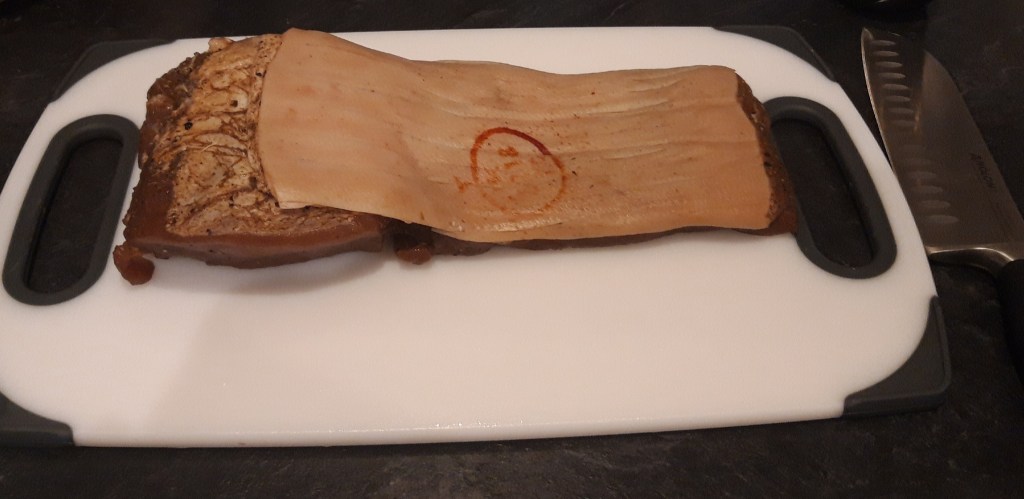
The smoked bacon should look like this; the skin or rind should cut off easily.

If you prefer to cook your belly pork in a smoker, a 1.5 kg piece of belly pork will often take up to 3 hours at 200oF or until the internal temperature of the pork reaches 150oF on the thermometer. If your smoker has a switch, set it to 200oF and soak 3 or 4 cups of wood chips in water for at least one hour before starting. Make 3 or 4 wood chip pouches. Cut out a 12” x 24” piece of heavy duty tin foil and place a cup of soaked wood chips on one end of the foil and add a handful of dry chips and fold foil over wooden chips. Fold all 4 edges of the foil towards the centre at least twice, poke holes on top of the pouch with a fork.

Lift the grill that’s above the lit element and place a pouch directly on the heat source. Close the lid and wait until smoke starts to escape from the foil pouch. Place the belly pork on the unlit side of the grill and close the lid. Smoke until the internal temperature reaches 150oF. Replace pouch every hour or so. Open the lid from time to time to let heat escape if the temperature is getting too warm. You may need to keep a close eye on it to maintain an even temperature so this method is not necessarily ideal if you need to go off and do something else for an hour or two. When the meat is ready, allow it to rest on a rack and baking sheet until it reaches room temperature and then wrap and refrigerate as in the conventional oven method.

Whether you choose to smoke your bacon in a conventional oven or over a smoker, after cooling and resting it may be stored for up to two weeks tightly wrapped in the refrigerator or, alternatively, sliced and wrapped in clingfilm and then foil (to prevent freezer burn) and transferred to a freezer for up to 3 months.

I have since tried curing a 1.1 kg piece of rolled pork loin for unsmoked back bacon, with equally successful results, but in this case I removed the butchers’ string before weighing the pork and prepping the dry cure. This is important to ensure that the cure can be effectively rubbed into the whole of the pork without missing any areas due to the presence of butchers’ string, so the pork can be cured fully and safely. I swapped paprika for crushed juniper berries and also added some fresh homegrown thyme to the cure, in addition to the other ingredients in my ‘go-to’ recipe.

The method is the the same as for streaky bacon, but instead of smoking the bacon after the curing and resting time, the loin can be cut into rashers on the long side of the meat before wrapping and storing in the refrigerator or freezer, as previously explained. Make sure that your knife is razor sharp so that it cuts through the meat cleanly like butter or, if you intend to cure your own bacon and charcuterie on a regular basis, you could invest in a meat slicer for around £65 on Ebay. or put it on your Christmas wish list!

Dan and I sliced and wrapped our bacon joints for both freezer and immediate use, and each time we had 5 or 6 packs of 6 flavourful rashers plus a 100g package of lardons to use in soups and stews. Dan took some to my brother, Robert, for he and his son Louie to enjoy, and over the following days and weeks I cooked with the rest.

A perfect plate of bacon, egg and crunchy fried homemade bread.

I will be curing another loin of belly or pork towards the end of November or early December in time for the festive season, and as I have also brined and cooked a joint of beef brisked for salt beef and will be curing some beef topside for braosola as well as a rolled pancetta, a meat slicer is definitely on my festive wish list!

One-Time
Monthly
Yearly

Make a one-time donation

Make a monthly donation

Make a yearly donation

Choose an amount

£3.00
£9.00
£60.00
£3.00
£9.00
£60.00
£3.00
£9.00
£60.00

Or enter a custom amount

£

Your contribution is appreciated.

Your contribution is appreciated.

Your contribution is appreciated.

DonateDonate monthlyDonate yearly
Sausages!

Featured

Tags

, , , , , , , , , , , ,

Didn’t we do well?!

Back in June, my husband Dan and I celebrated our 12th wedding anniversary in Lockdown with a day of sausage-making followed by a socially-distanced barbecue with our next-door-neighbours, Aidan and Sophia.

The art of sausage-making involves some scientific know-how and there is an obvious difference between making fresh sausages and those that you do not intend to eat right away.

Fresh sausage does not normally need curing salt, just a teaspoon of sea salt, freshly ground black pepper, whatever herbs, spices and other flavourings you like such as apple, sun-dried tomatoes or ale, breadcrumbs or oatmeal and the best quality meat you can afford. However, if you intend to experiment with curing some of the mixture or wish to store fresh raw sausages in the refrigerator for 2-3 days, then you will need to substitute curing salt for sea salt. You may also store your fresh sausages in the freezer well-wrapped for up to 3 months, but freeze them on the day you have made them and consume them within the time frame. Making your own sausages also gives you control over the quality of the other ingredients as shop-bought sausages often contain more unsavoury parts of the animal such as snout, gums, connective tissue and so forth.

If you want to keep your bangers in the refrigerator for 2-3 days before eating them or intend to have a go at producing air-dried sausage, such as chorizo, it is important to add a special curing salt, such as potassium nitrate or pink curing salt, to your sausage recipe in order to avoid botulism. The amount of curing salt varies according to which curing salt you choose and which type of sausage you are making but in the case of chorizo, for example, it is common practice to add 0.5g of potassium nitrate per kg of meat or 2.5g of pink curing salt per kg of meat, which is about half a teaspoon.

The method of curing also varies and is often very precise. Chorizo is often air dried by hanging up in an area with a steady temperature of between 50 and 60F and a humidity of 65-80F, but some people prefer to use an air dryer. Temperature and humidity are very important to avoid problems such as case hardening, which occurs when the cases cure faster than the meat inside. This usually happens when there is not enough humidity and the meat inside will not cure properly, although it is more of a problem with fatter sausages such as salami.

Occasionally mould will form on the sausage casing. White powdery mould is usually safe, but if it forms simply wipe it off with apple cider vinegar. If green mould forms on the outside of the casing do likewise, but if it is another colour such as blue or black you will need to throw the sausage away.

If the sausage does end up dryer on the outside than the inside, wrap in waxed paper or cling film and pop it in the refrigerator for a few days which will usually correct the problem, as the humidity left in the sausages will even out, leaving a more balanced sausage.

Air dried sausage is ready to eat when it has lost at least 35% of its original weight, so make sure you weigh the sausage before you hang it up to dry and then weigh it again before cutting, when it is firm to the touch by squeezing it.

If you are thinking about curing your own sausages in this way, making a small batch of fresh sausage (containing curing salt instead of sea salt and a variety of other seasonings) for eating right away and air drying one or two of the links to experiment, may be a step forward.

Dan and I chose to make fresh sausages by hand after grinding the ingredients in a food processor, as we did not have a sausage-maker or meat-grinder.

Mixing the ingredients – this was the beef mixture

Because I wanted to make some vegetarian haggis sausages for myself, I bought one stick of Viscofan 30mm diameter 100% plant-based sausage skin from the Ebay UK seller butcherssundries_online, which cost me £8.99 including free p&p for one 15.24 metre stick. Viscofan are world-leaders in producing the finest quality sausage skins, using state-of-the-art technology to form their ingredients into casings. The casing I bought is 100% vegetarian, gluten-free, GMO-free, allergen-free and are also suitable for vegans. They are also marketed as having an excellent natural look with good frying qualities and a tender bite. The all-one-length stick is sectioned at approximately 2.5 cm intervals in folded form, which we found produced an average yield of 6 sausages and also allowed us to cut off the length of casing we needed without wasting any, knotting the cut-off end to secure before stuffing.

We started with the ingredients for the vegetarian haggis sausages, then the pork and tomato and finally the beef and red wine ones, washing the food processor thoroughly afterwards between each batch of ingredients to avoid cross-contamination. As we had no sausage-maker we first tried piping the mixture into the skin, which wasn’t very effective, but I had a brainwave and we inserted a small funnel into the open end of the casing and pushed the mixture through the funnel with clean fingers and the handle of a wooden spoon. We made sure the sausage casing was well-filled before twisting at each interval to form the individual sausage shapes, but this was the tricky part as the casing seemed less pliable than we expected so we needed to twist it several times to stay in place.

Stuffing the skins

All the sausages cooked perfectly on the barbecue, the skins did not burst and had a tender bit. We set the grill higher over the coals to allow the sausages to cook evenly. There is nothing worse than a sausage burnt on the outside and still half-cooked on the inside. We wrapped the haggis sausages in foil and placed them in a foil tray with some water and steamed them over the barbecue. All the sausages had a good consistency and tasted delicious and we all enjoyed what we ate. I served all the sausages with a good vegetarian red wine reduction, a foil tray of onions gently fried and then placed over the barbecue covered with heavy-duty foil and some creamy mashed potato, and we shared a good bottle of Champagne.

Below are my sausage recipes – simply combine all ingredients in a food processor or meat grinder before making into sausages. I eyeballed most of the ingredients based on instinct, but if you’re not a confident cook then feel free to use your own weights and measures.

BEEF AND RED WINE SAUSAGES

  • 500g minced beef – drizzled with a good glug of Merlot and allowed to marinate overnight
  • A good handful of fresh breadcrumbs or oatmeal
  • Fresh thyme, leaves only
  • Sea salt and freshly ground black pepper

PORK AND TOMATO SAUSAGES

  • 500g minced pork
  • A good handful of fresh breadcrumbs or oatmeal
  • 3 tbsp tomato paste
  • Chopped sun-dried tomatoes if liked
  • Fresh thyme and chopped sage, leaves only
  • Sea salt and freshly ground black pepper

VEGETARIAN HAGGIS SAUSAGES

  • Can butter beans, drained and mashed
  • A good handful of oatmeal
  • Chopped garden herbs, leaves only – thyme, rosemary, marjoram
  • A good handful of vegetable suet
  • A glug of sunflower oil
  • 1 tsp ground allspice
  • Sea salt and lots of freshly ground black pepper

We have since invested in a combined sausage-maker and meat-grinder and had a date making turkey and chorizo sausages seasoned with hot and smoked paprika, which turned out really well. We gave some to my brother and he loved them!

One-Time
Monthly
Yearly

Make a one-time donation

Make a monthly donation

Make a yearly donation

Choose an amount

£3.00
£9.00
£60.00
£3.00
£9.00
£60.00
£3.00
£9.00
£60.00

Or enter a custom amount

£

Your contribution is appreciated.

Your contribution is appreciated.

Your contribution is appreciated.

DonateDonate monthlyDonate yearly
Gypsy Tart

Tags

, , , , , , , , , , , ,

Gypsy Tart is a dessert from the Isle of Sheppey in East Kent, in the south-east of England. It comprises a shortcrust pastry base, with a whipped evaporated milk and dark muscovado sugar filling, baked in the oven.

Legend has it that a woman on the Isle of Sheppey took pity on some impoverished-looking gypsy children and invented a tart using whatever ingredients she could find in her home with which to feed them. Whether or not this tale is true, gypsy tart was always popular in school meals.

Although purists might make gypsy tart with regular evaporated milk, condensed milk may be used instead as it is simply evaporated milk that has been sweetened. Whether you prefer to use evaporated or condensed milk in your recipe, always chill the can in the refrigerator for at least 30 minutes before you need it, but preferably overnight.

This tart is very sweet and using condensed milk instead of evaporated milk will make it even sweeter with a darker colour, so I would recommend adding less sugar in the mixture. Light muscovado sugar can also be substituted for the molasses-rich dark variety and will also produce a lighter colour.

My version of this tart has a gluten-free pastry case. The flour blend I used already contained Xanthan gum, which acts as a stabilizer, but you will need to add a little extra to ensure the pastry holds together well. If you are not a coeliac or sensitive to gluten, then you may use regular plain flour.

I made a slightly sweet shortcrust pastry which I mixed in a food processor, but the pastry can also be made by the traditional rubbing-in method if you prefer. The pastry case should be baked blind before the filling is added. I brushed beaten egg on the pastry base for the last few minutes to seal it and prevent any leakage from the filling. The rest of the beaten egg can be used in another recipe but I added mine to the mixture and stirred it in thoroughly to combine.

It is crucial to whisk the evaporated milk or condensed milk with the sugar until it thickens sufficiently in order to ‘set’ during baking, otherwise even if it is cooked the filling will go everywhere – although it will still taste delicious either on its own or perhaps with a dollop of crème fraiche. I sprinkled a little cinnamon and nutmeg over the tart before popping it into the oven. The tart is ready once the filling has risen and the surface is tacky. Leave to cool before serving to allow the filling to set.

INGREDIENTS

For the pastry

  • 225g plain (all purpose) gluten-free flour, sifted – I used Dove’s Farm
  • 1 tsp Xanthan gum
  • Pinch of salt
  • 100g unsalted butter, diced
  • 50g icing sugar, sifted
  • 1 medium free-range whole egg, plus 1 beaten.

For the filling

  • 397g can condensed milk or 410g can evaporated milk
  • 250g dark muscovado sugar (300g if using evaporated milk)

First of all, make the pastry. Put the icing sugar and butter in a food processor, add one egg and whizz until combined. Then add the flour and xanthan gum and whizz again until the mixture just comes together. If the mixture still looks crumbly, add a teaspoon of cold water and pulse, repeating if necessary to avoid overworking the pastry.

Dust your clean work surface with flour, turn the dough out on to the work surface bringing it together with your hands and knead lightly, shaping the pastry into a ball or a flat disc. Wrap in cling film or greaseproof paper and chill in the refrigerator for 30 minutes to allow the dough to relax, which produces a lighter, shorter pastry for a good tart base.

Heat the oven to 180C/160C fan/350F/gas 4 and grease the base and sides of a 20-23cm tart tin.

If you have made gluten-free pastry, it might be necessary to knead it very lightly before rolling out. Roll out the pastry to about the thickness of a £1 coin and lift it carefully round your rolling pin and into the greased tart tin carefully pushing the pastry into and up the sides of the tin. Prick the base all over with a fork and return to the refrigerator for another 20 minutes to harden.

Line the pastry case with scrunched-up greaseproof or baking paper, fill it with ceramic or glass baking beans (use dry rice, beans, pasta or lentils if you have no baking beans) and bake in the oven for 15-20 minutes. Remove the baking beans, brush the beaten second egg over the base and return to the oven for 3 minutes or until the base is golden and the sides set. Reduce the oven temperature to 170C/150 fan/325F/gas 3.

Meanwhile, make the filling. Beat together the condensed or evaporated milk and the sugar together in a bowl with a hand-held mixer or in a stand mixer until the mixture is light and fluffy. This may take up to 20 minutes. Fold in the rest of the beaten egg, if using and pour the mixture into the pre-cooked pastry base and bake for 15 minutes or until risen and the surface is tacky. The tart is ready when there is a slight film over the surface.

Remove the tart from the oven and leave to cool and set before serving. Any leftover tart may be covered over and stored in the refrigerator. Eat within a couple of days.

COOK’S NOTES:

When making the pastry base, you may substitute caster sugar for icing sugar or you may omit the sugar completely for a slightly less sweet tart.

If you want a deeper tart, use a deeper 20cm tart tin rather than a 23cm regular tart tin.

Serve your tart on its own, sprinkled with a little sifted icing sugar or any cream of your choice perhaps with a little citrus zing of finely-grated lemon or lime zest which will help to cut through the sweetness.

One-Time
Monthly
Yearly

Make a one-time donation

Make a monthly donation

Make a yearly donation

Choose an amount

£3.00
£9.00
£60.00
£3.00
£9.00
£60.00
£3.00
£9.00
£60.00

Or enter a custom amount

£

Your contribution is appreciated.

Your contribution is appreciated.

Your contribution is appreciated.

DonateDonate monthlyDonate yearly

One-Time
Monthly
Yearly

Make a one-time donation

Make a monthly donation

Make a yearly donation

Choose an amount

£3.00
£9.00
£60.00
£3.00
£9.00
£60.00
£3.00
£9.00
£60.00

Or enter a custom amount

£

Your contribution is appreciated.

Your contribution is appreciated.

Your contribution is appreciated.

DonateDonate monthlyDonate yearly
Brill with lemon butter, samphire and foraged sea beet

Tags

, , , , , , , , , , , , , , , , , , ,

undefined

There is nothing quite as wonderful as fish at its freshest; bright clear eyes, firm flesh with lovely shimmery scales, bright red gills covered with clear slime and a fresh odour, and belly walls intact. Fish is packed with essential vitamins and minerals and prepared and served simply, perhaps with a salad and some new potatoes, it makes a healthy, delicious and nutritious lunch or supper. Fresh fish is also very versatile – marinate it and serve it raw in sushi or ceviche, poach it, roast it, stuff the belly with herbs and grill or bake it, steam it, barbecue it, curry it, pan fry it, the possibilities are endless

In Ramsgate and Broadstairs, where I live, fresh fish from the fishmongers is high quality, competitively priced compared to the supermarkets with a good variety to choose from despite all the bureaucracy, fish quotas and declining fish stocks which have battered the British fishing industry over the decades; let’s not get on to the politics of that here just yet, suffice to say that UK fishing rights are currently taking centre stage in negotiations with the EU regarding any Brexit deal we might strike and the future of our fishermen’s livelihood, and that of the fish that swim in our seas, are being fought for tooth and nail.

I shop mostly at the two remaining local fishmongers, either Fruit de Mer of 10 The Broadway, Broadstairs who have 15 or 16 day boats, or Cannons stall on a Friday or Saturday at Ramsgate Harbour. At one time, fishmongers in Thanet were plentiful – in Ramsgate alone, there used to be 8 wet fish shops – but one by one they shut up shop as the once-buoyant industry became ever more unpredictable and constrained by red tape, fishing quotas and climate change and, more generally in the economic stakes, Thanet got left behind.

Owned by Jason Llewellyn, Fruits de Mer are the last remaining fishmongers in Broadstairs. Jason began working there at the age of 11 and when he was 17 he bought out the business. Fruits de Mer are renowned suppliers of high-quality fresh fish and shellfish in the south-east of England and are one of the finest in the country. They source sashimi-grade fresh fish and shellfish daily from the clear waters around the Thanet coastline. Their catch is sourced and landed in an ethical and sustainable way and arrives within hours at the shop where the high quality lobsters and crabs are prepared, cooked and dressed to order.

All their fishing boats are under 10 metres and each boat fishes either single-handedly or with only one extra crew member. Dedicated potting boats target the local shellfish, while the netting and lining boats target the array of fish including bass, turbot, brill, skate and gurnard, the focus always being on what species are in season.

Fruits de Mer supply some 200 fine dining establishments and public houses throughout Kent, as well as Michelin-starred restaurants, with the most amazing fish including line-caught bass, turbot, brill and Dover sole. They have also supplied Buckingham Palace and major international events, including The Monte Carlo Grand Prix, and various television programmes such as The Great British Menu. However, what isn’t reserved for the shop and its regular customers will often land on European tables every day.

Situated opposite the Clock Tower and often served by Michael Penn (who himself once owned a fish shop), Cannons Fishmongers and Seafood Stall on Ramsgate Harbour Parade are a family-owned business established in the late 1880s and are the only remaining fishmongers in Ramsgate. They sell quality fresh local fish and shellfish and offer pre-ordered shellfish platters for £30 comprising whole lobster, dressed crab, oysters, langoustines, crevettes and shell-on prawns, and are proud to supply many of the businesses in the area. Specialities on the stall include local lobsters and crabs, but the locally caught fish including sea bass, cod, skate and haddock I also highly recommend. Again, a fresh and sustainably-sourced catch is key and arrives on the stall within hours of being landed. Now in his mid-seventies, Michael has been a fishmonger for over 40 years and went to work at Cannon’s 14 years ago when his own shop closed. He once told me that he could not contemplate retirement as he would get bored and selling fish keeps him feeling young at heart.

Brill (scophthalmus rhombus)is a flat fish in the turbot family but without the fancy turbot prices and is often found in deeper waters in the English Channel. Similar in taste and appearance to turbot, brill has a distinctive light brown skin with white, black and grey speckles all over the body and beautiful creamy white flesh on the underside. It has a sweet taste and firm texture and is amazing either pan fried or grilled. Brill will feed on fish but mostly prawns, crustaceans and marine worms and can reach up to 3ft long and 20 lb in weight.

During the spring, fully-grown brill do venture into shallower water to spawn in sandy or muddy ground and may also live on shingle seabeds. They are not fussy eaters and will interchange between scavenging and hunting. They will search the seabed for any marine worms, invertebrates, lobsters, crabs, prawns and will also hunt any low-lying fish and sand eels. Because of their likeness to turbot, the two species are often confused, however turbot have a rounder body shape and rougher skin whereas brill are more elongated and are smoother. Often trawled, brill are a species on the IUCN list of Least Concern as the commercial pressure on this sea fish is not regarded as a cause for worry.

The best time to target brill is in the spring when it is in season, although boat anglers are able to catch the fish pretty often because of the deeper, offshore water they prefer, anything from 10 metres to 100 metres deep. Most shore anglers will only catch brill during the spring breeding season when they are in range at a distance over sandy or shingle sea beds. The best way to maximise the distance of casts is by using clipped down rigs with hooks 1/0 – 2/0 in size to enable larger specimens to be caught, but smaller brill are still able to fit the hook into their mouth, tempted by a bait of mackerel strip, peeler crab, squid and worm when the fish is present and feeding.

The brill I used for my recipe comprised two large fillets from Fruits de Mer in Broadstairs. which I bought and cooked in early May along with a good handful of samphire from the same place, plus a side of wilted sea beet (wild spinach) foraged from Pegwell Bay.

INGREDIENTS (Serves 2)

  • 2 large local fillets of brill, skin on
  • Handful of Samphire
  • Sea beet or spinach
  • Unsalted butter
  • Zest and juice of half a lemon
  • Sea salt and freshly-ground black pepper

Rinse the fillets of brill in clean, cold running water and pat dry on kitchen paper. Season with sea salt and freshly ground pepper and set aside.

Meanwhile pick the tough stalks off the foraged sea beet, or alternatively a regular bag of spinach, place in a colander and wash well under cold running water. Shake well and set aside.

Place the bunch of samphire in a colander and rinse well under cold running water. Shake well and set aside.

Place a skillet on a medium heat, add a generous knob of butter and a little olive oil to the pan. The olive oil will prevent the butter from burning. When the butter has melted and starts to sizzle, place the brill fillets in the skillet one by one, skin side down, holding each fillet by the tail and placing it gently in the pan away from you to avoid splashes and scalding. Cook the fillets for 2-3 minutes on each side, flipping over when the skin side down starts to look crispy and the flesh opaque. To check, gently ease a fish slice or palette knife underneath the fillet, turn the fillet over and cook for another 2-3 minutes. Remove the brill fillets from the skillet and place on absorbent kitchen paper or a j-cloth while you make the sauce.

Meanwhile place a saucepan or skillet over a medium heat and then add a drop of salted water. Once it starts to simmer, add the spinach leaves and wilt down for about 30 seconds. Remove from the heat.

To make the sauce for the fish, add more butter to the skillet and toss in the samphire turning quickly and add the zest and juice of half a lemon and season with sea salt and freshly ground black pepper. Toss the samphire again and remove from the heat.

To plate up, remove the wilted spinach leaves from the pan and place some in the centre of each plate. Place a brill fillet on the spinach, skin side down, and then spoon the samphire and the lemon butter mixture over the top of the fish. Serve with buttered new potatoes or a generous spoon of creamy mashed potatoes.

NOTES – Brill is also delicious served with a lobster sauce or gremolata or baked whole with green pesto.

One-Time
Monthly
Yearly

Make a one-time donation

Make a monthly donation

Make a yearly donation

Choose an amount

£3.00
£9.00
£60.00
£3.00
£9.00
£60.00
£3.00
£9.00
£60.00

Or enter a custom amount

£

Your contribution is appreciated.

Your contribution is appreciated.

Your contribution is appreciated.

DonateDonate monthlyDonate yearly

Buttered Asparagus with Poached Eggs and Wild Fennel

Tags

, , , , , , , , , , , , , , , , , , ,

Asparagus is a tasty and versatile spring vegetable that can be prepared and served in a number of ways. Although it is now possible to source the vegetable in the supermarkets throughout the year, traditionally the asparagus season is a short one and in the United Kingdom is at its best during the month of May.

Asparagus is an herbaceous, perennial plant growing to a height of 100-150cm (39”-59”) with thick stems and multi-branched, feathery foliage.  The asparagus plants native to Western Europe – from northern Spain to northwest Germany, Northern Ireland and Great Britain, are labelled Asparagus officinalis subspecies prostratus dumort and distinguished by their low-growing, often horizontal stems which grow to only 30-70 cm (12 -28”) tall. Sometimes it is treated as a distinct species, Asparagus prostratus Dumort.

Asparagus has a distinct flavour and a long history. It has been used for centuries both as a vegetable and in medicine due to its diuretic properties and reputation as an aphrodisiac. It is depicted as an offering on an Ancient Egyptian frieze dating to 3000BC and was also well-known in Syria and in Spain. The Ancient Greeks and Romans ate it fresh when in season and would also dry it for culinary use in winter. High up in the Alps Roman Epicureans froze asparagus spears for the Feast of Epicurus while the Emperor Augustus created an “Asparagus Fleet” for carrying the vegetable and introduced the term “faster than cooking asparagus” for quick action.

One of the oldest-surviving recipes for asparagus dates back to the third century BC in ancient Rome. In the second century BC, the highly-respected Greek physician Galen noted asparagus as a beneficial herb but its popularity waned with the demise of the Roman Empire until the 15th century when the Arabic author Muhammed Al-Nafzawi wrote about it in his erotic literature “The Perfumed Garden”, discussing the aphrodisiacal power of asparagus; meanwhile, the Indian sex-handbook “Ananga Ranga” mentions the “special phosphorous elements” of asparagus that help to overcome fatigue.

In Medieval times, French monasteries started cultivating asparagus by 1469, though the vegetable was overlooked in England until 1538 and in Germany until 1532. The asparagus tips, or points d’amour, were served as a delicacy to Madame de Pompadour, otherwise known as Jeanne Antionette Poisson or the Marquise de Pompadour. This lady of renowned beauty and influential patron of the arts was the official mistress and confidante of King Louis XV of France and led a colourful life during her 41 years, eventually consumed by tuberculosis.

The European settlers brought asparagus to the shores of North America circa 1655 when Adriaen van der Donck, a Dutchman who immigrated to New Netherland, mentions the vegetable in his account of Dutch farming practices in the New World. British immigrants also cultivated asparagus and in 1685 in Pennsylvania, William Penn advertised asparagus in a long list of crops that flourished in the North American climate.

I currently live in East Kent in the south-east of England and Kent itself is known as “the garden county of England” due to its abundance of fruit- and vegetable-growing, hop-gardens and vineyards and rich agricultural pasture that flourish in the temperate climate. Some 28% of the county forms two Areas of Outstanding Natural Beauty, being the North Downs and the High Weald, whilst reaching out as far as the coast.

Our local asparagus farm is Sevenscore, near Ramsgate on the Isle of Thanet. Thanet is an island at the most easterly point of Kent approximately 30 miles from France, and was once separated from the English mainland by the 600m-wide Wantsum Channel which over the centuries gradually became silted up. Archeological evidence reveals that Thanet was inhabited by ancient peoples, including Bronze and Iron Age, who spoke a Celtic language. One original meaning of Tanet, as it was once known, is said to be Fire or Bright Island (tân meaning fire in Modern Welsh and tan in Breton), which suggests that an ancient beacon or lighthouse may once have stood.

Another theory explains Tanet as a common European construct of Celtic origin, based on the Celtic word tanno meaning “holm oak” (perhaps an amalgamation of the Breton word tan meaning “sort of oak” and the Cornish glastannen meaning “holm oak”) with the Celtic suffix etu,  meaning a “collection of trees”. Thanet would thus mean “place of the holm oaks”, for example the Northern French Thenney, Italian Tenado, and so forth. The common names tan, tanner and tannery, would also have the same Celtic root tanno in their origins.

In the 9th century AD, the Historia Brittonum written in Wales states that Tanet was the name given to the island by the legendary Anglo-Saxon brothers, Hengist and Horsa, who were said to have led the Angles, Saxons and Jutes in their invasion of Britain in the 5th century AD, and Hengist became the first Jutish King of Kent. These two brothers arrived in Ebbsfleet on the Isle of Thanet. To begin with, they served as mercinaries to King Vortigern of the Britons but they later turned against him in “the Treachery of the Long Knives”. Horsa was killed in combat with the Britons but Hengist succeeded in conquering Kent and became the forefather of its kings.

Sevenscore Asparagus Farm are vegetable producers in the hamlet of Sevenscore, near Ramsgate, on the B2048 secondary road about one mile east of Minster-in-Kent. The seasonal farm shop is open each year from the end of March to the middle of June, selling their home grown asparagus, Kentish cauliflowers and purple sprouting broccoli.

The family-run farm was established in 2005 but the farmhouse and outbuildings are at least 17th century or older. Each day the asparagus is cut by hand to ensure freshness and quality before being quickly brought to the cutting room and shop where it is carefully washed, graded and prepared for sale. The farm also supplies many of the best hotels and restaurants in the area as well as a number of top London restaurants and the main markets in New Covent Garden.

My husband Dan and I visited the Asparagus Farm one Saturday in April during Lockdown and there was a wide range of asparagus from the Kitchen Asparagus suitable for general purpose, to Salad Asparagus in 6mm spears; from Select Asparagus with 10-16mm spears to Jumbo Asparagus with spears of at least 20mm in diameter. Prices are based on per kilo and width of spear, and 5 kg boxes of asparagus are also available.

The asparagus is sold loose in the Farm Shop, allowing customers to select as much or as little as they like, although banded bundles may be ordered in advance for a 50 pence surcharge. We bought a little over 500g of loose Kitchen Asparagus at £5.80 per kilo for just £2.72.

When preparing asparagus, wash carefully and chop off the tough, fibrous woody end of each spear and reserve for stock. For my recipe, use fresh free-range eggs, local if possible. I used local free-range eggs with a deep yellow yolk from Rose’s Farm Shop, Ramsgate, and local fennel tops we foraged from Pegwell Bay. If you store your eggs in the refrigerator, remove them about 30 minutes before you plan to use them to achieve best results. It is also important not to season the eggs until the very end of the cooking process, otherwise they will turn grey and watery and unappetising.

My recipe is a healthier one, stirring a knob of good unsalted butter through the asparagus rather than serving the dish with hollandaise sauce, although for an indulgent brunch or light lunch or supper you can serve it with hollandaise or as well butter if you prefer.

INGREDIENTS (Serves two)

250g Asparagus

2 Local Free-Range Eggs

White wine vinegar or apple cider vinegar

Unsalted Butter

Fennel tops

Set a lidded skillet half fill with water and a dash of white wine or apple cider vinegar on the stove on a medium heat and bring to a steady simmer.

Meanwhile, carefully wash and prepare asparagus spears, cutting off the woody part of the stems. Set the spears aside, then wrap the stems in clean newspaper and reserve for the stockpot in a cool, dry place.

Put a medium saucepan on a good heat and, at the same time, boil a kettle of fresh water, pour in a teacupful of boiling water and a good pinch of sea salt and put the lid on the pan.

Just before the skillet of water comes to the boil, remove the lid and carefully crack in the eggs without breaking the yolks, turn down the heat to a gentle simmer and replace the lid. After 30 seconds turn off the heat and allow the eggs to poach in the residual heat of the poaching water. They should be ready within 5 minutes, depending on how soft or hard you like your eggs.

While the eggs are poaching, place the prepared asparagus spears in the saucepan, return the lid  and steam the asparagus for about 2 minutes. This method will ensure you retain more of the nutrients.

Remove the saucepan from the heat, drain the remaining cooking water into a teacup to reserve for stock, soups or stews, return the asparagus to the heat and add a good knob of unsalted butter, a squeeze of lemon juice if liked, and a pinch of salt and freshly ground black pepper, stirring through quickly to combine.

Remove the asparagus from the saucepan and divide between two warmed plates.

Carefully remove the poached eggs from the skillet and place one on each plate, season with a pinch of sea salt and freshly ground pepper and dress with sprigs of foraged fennel tops. Serve with a slice of fresh artisan sourdough bread and butter.

Bon appetit!

COOKS TIPS

For an indulgent brunch or light lunch or supper dish, serve with a good shop-bought or homemade hollandaise. To make hollandaise, melt 125g unsalted butter and skim off any white solids from the surface. Keep butter warm. Place 2 egg yolks, ½ tsp white wine vinegar, a pinch of salt and a drizzle of ice-cold water in a metal or heat-proof glass bowl and whisk for a few minutes before placing the bowl over a small pan of just-simmering water and continue whisking for another few minutes until pale and thick. Remove from heat and gradually whisk in the melted butter until it is all incorporated and has a smooth, creamy texture. If it is too thick add a dash of cold water. Season with a squeeze of lemon and a pinch of paprika or cayenne pepper. Spoon warm over eggs.

For a more substantial meal, allow two eggs each, place each egg on half a toasted English muffin or crumpet and garnish with fresh watercress.

One-Time
Monthly
Yearly

Make a one-time donation

Make a monthly donation

Make a yearly donation

Choose an amount

£3.00
£9.00
£60.00
£3.00
£9.00
£60.00
£3.00
£9.00
£60.00

Or enter a custom amount

£

Your contribution is appreciated.

Your contribution is appreciated.

Your contribution is appreciated.

DonateDonate monthlyDonate yearly

DAMPER BREAD WITH SEEDS

Tags

, , , , , , , , , , ,

Damper Bread with Seeds

During Lockdown2020 it has often been quite difficult to source strong bread flour and yeast, due to people’s renewed interest in baking when long days at home are often focused on finding things to do with the kids or perhaps to perform a good deed for an elderly or self-isolating neighbour who cannot get to the shops and deserves a tasty treat. Even bread itself has sometimes been in short supply. When shelves are empty of ingredients and you need bread, what can you do? Making bread with all-purpose (plain flour) with added baking powder or, alternatively, by using self-raising flour mixed with water, a little salt and one or two extra ingredients if you like – whatever you fancy and have in the store cupboard – can produce a wonderful bread with delicious results.

Damper bread, or damper, is one of my favourite soda breads to eat. It is quick and simple to make, fuss-free with no ‘proving’ of the dough and very versatile. You can add whatever extra ingredients you like to vary the taste each time you make it; chopped olives or sundried tomatoes, herbs, seeds, a teaspoon or two of turmeric powder, walnuts, dates, finely chopped onions, even dried mixed fruit, the choice is yours. In this recipe, I have chosen to use mixed seeds from a health food store and I am using light spelt flour as it is lower in gluten and has a wonderful nutty flavour.

Traditionally a wheat-based bread, damper originates from Australia, when it was first prepared by the early settlers – swagmen, drovers, stockmen and a variety of other travellers – and cooked in the ashes of a campfire or in a camp oven in the outback. Back then it was a staple part of their diet. The early settlers travelled in remote areas for long periods of time and had with them only basic rations comprising flour, sugar and tea supplemented by whatever meat was available. The basic ingredients of a damper bread were flour, water and sometimes milk, and baking soda could be added for leavening. The damper was then cooked in the embers of the campfire. The ashes were flattened and the damper was placed on them and cooked for about 10 minutes. The bread was then covered with ashes and cooked for another 20 or 30 minutes or until it sounded hollow when tapped on the base. The damper could also be cooked in a greased camp oven instead, but in any case it was usually eaten with dried or cooked meat or golden syrup.

Today, damper still remains a popular Australian dish and might be served at a special occasion such as Australia Day. The basic recipe remains much the same but will sometimes contain melted butter. Damper is also popular in New Zealand and South Africa, where it is cooked on a barbecue and perhaps served alongside a meaty braai, for example.

As a young child I lived in Zambia in Southern Africa in the late 1960s/early 1970s and when I was 6 years old learned to cook over an open fire and fire, be it campfire or barbecue, is still one of my favourite cooking methods. It is possible to cook almost anything in this way and indeed I do when the weather is kind!

Preparation time: 30 minutes
Cook: 30-35 minutes
Serves 8

INGREDIENTS

450g all-purpose (plain) flour – you can also use plain spelt or wholemeal flour.
3 tsp (1 tbsp) baking powder – I used Dr Oetker
1 tsp fine sea salt
8 fl oz lukewarm water
1 tbsp Extra Virgin Olive Oil.

  1. Preheat your oven to 200C (Gas Mark 6).
  2. Meanwhile, in a large bowl, place the flour, salt and baking powder and stir together with a spoon or fork.
  3. In a jug, combine the olive oil and the water, make a well in the centre of the dried ingredients and pour in the oil and water.
  4. Add a handful or two of dried mixed seeds and stir in to incorporate. With clean hands, start to knead gently and bring the mixture together into a dough. Add a splash of extra water if necessary if the dough appears a bit dry.
  5. Turn the dough out on to a clean, floured board and knead the dough until it feels nice and smooth and shape it into a ball.
  6. Place the dough on an oiled baking sheet and mark out 8 segments with the handle of a wooden spoon. Bake in the oven for about 35 minutes.
  7. The bread is ready when you tap the underside and it sounds hollow. Leave on a wire rack to cool and enjoy with butter, some balsamic and olive oil, a little syrup or honey and/or as part of a more substantial meal.

Notes

Substitute self-raising flour for all-purpose if you prefer or do not have plain flour in the store cupboard but do not add baking powder.

Instead of adding seeds, why not try finely chopped onion or bell pepper, chopped herbs or walnuts, chopped olives or sun dried tomatoes or perhaps some raisins?

Oven temperatures vary so check your bread after 30 minutes if it smells cooked or you have a ‘fast’ oven.

Enjoy!

Basil Gnocchi with Mediterranean Vegetables

Featured

Tags

, , , , , ,

During the Lockdown period I have seen a few TV programmes featuring celebrity chefs preparing gnocchi.

Now, I have tried pre-packaged gnocchi from the supermarket several times in the past but it was never to my liking. It often has a strange, slimy texture and is under seasoned, tasting of very little at all; an underwhelming dining experience, it must be said.

For me, texture is a very important consideration when preparing meals. If something looks and tastes ‘wrong’ to my palate I am unable to eat it and I am sure many people share my sentiments. Gnocchi has usually had this effect upon me, thus I tend to avoid it.

However, recently having watched TV programmes showcasing tempting plates and inventive recipe ideas with gnocchi, and then discovering that gnocchi is a slightly healthier alternative to traditional white pasta, I did wonder whether I might be missing out on a taste sensation and might perhaps have more luck making my own gnocchi and, at the same time, make it gluten- and egg-free, so I decided to give it a go.

Gnocchi are little Italian soft dough dumplings often made with a blend of semolina or wheat flour, mashed potato, egg and seasoning and can be fried, baked or boiled. Other ingredients might include cornmeal or breadcrumbs, cheese or egg, and flavourings such as vegetables, herbs, cocoa or prunes.

I used Doves Farm plain (all purpose) gluten-free flour which is a blend of rice, potato, tapioca, maize and buckwheat and is also suitable for a Kosher diet. Recipes online suggest baking rather than boiling gluten-free gnocchi but I saw no reason why the little dumplings could not be boiled as long as handled with the love and respect any handcrafted product deserves.

One of the most important things is to use floury potatoes and make sure they steam dry before mashing and that it is well-seasoned with salt and pepper. The potato can be boiled first or baked in its jacket in a microwave oven before mashing A potato ricer, if you have one, makes it easier to get a nice smooth texture with no lumps, otherwise use a conventional potato masher and some elbow grease, but for my recipe do not add milk or butter or any beaten egg. Simply combine the potato with the plain flour, add chopped sage or any chopped herbs of your choice, and season well with sea salt and freshly ground pepper.

Form the gnocchi dough into little balls or lozenge shapes and use the back of a fork to create a crinkle effect, before boiling in a pan of salted water for a couple of minutes. When they are ready, the gnocchi will rise to the surface. Remove them with a slotted spoon on to kitchen paper to drain and then serve with any sauce of your choice – or even a simple drizzle of garlic infused olive oil and torn basil leaves, or a little pesto or sun dried tomato tapenade.

For a heartier plate and to keep this recipe vegan, any tomato-based sauce goes well with gnocchi, whether you roast whole cherry tomatoes in an oven with garlic and balsamic vinegar or use tinned chopped tomatoes. For a vegetarian, gnocchi can be enjoyed with roasted butternut squash and goat’s cheese or perhaps some spinach and ricotta. I decided to serve the gnocchi simply with a side of roasted Mediterranean vegetables – diced aubergine (eggplant), roughly chopped onions, tomatoes, courgette, tomatoes and bell peppers and a drizzle of balsamic vinegar.

I found the gnocchi cheap to make and easy to prepare, and the time taken was worth the effort as the result was delicious. I have discovered a liking for freshly-prepared gnocchi, they are tasty, filling and versatile and I will enjoy experimenting with different flavour and texture combinations.

Ingredients (serves 4)

For the gnocchi

  • 400g   Potatoes, mashed
  • 50g     Gluten-free Plain flour
  • Salt and freshly-ground black pepper
  • Finely chopped fresh or dried basil

For the vegetables

  • 1 Aubergine diced into 2cm chunks
  • 2 courgettes diced into 2cm chunks
  • Whole cherry tomatoes or quartered vine-ripened tomatoes
  • 2 red onions, roughly chopped into chunks
  • Red and Yellow Bell Pepper, deseeded and sliced into strips
  • Crushed garlic cloves (optional)
  • Olive oil
  • Balsamic Vinegar
  • Sea salt and freshly ground black pepper
  • Torn basil leaves (to serve)
  1. Boil floury potatoes in their skins in salt water, drain thoroughly and return to the pan to steam dry. Alternatively, microwave potatoes in their skins until cooked through.
  2. Wash and prepare the vegetables, drain well on kitchen paper and place in a roasting tin with some crushed garlic cloves if liked and a good glug of olive oil, a splash of balsamic vinegar and season with sea salt and freshly ground black pepper. Place in a medium oven and roast for 20-25 minutes or until tender.
  3. On the hob, heat a large pan of salted water and bring to the boil.
  4. Meanwhile, as soon as the potatoes are cool enough to handle, peel the skins away with clean hands and either push the potatoes through a potato ricer or mash to remove any lumps. Turn potatoes out on to a large board.
  5. Measure out 50g plain flour on to the board and gently mix into the potatoes, along with chopped fresh or dried basil to your liking and season well with salt and freshly ground pepper. Add a little more flour if you think it is necessary, but only add one tablespoon at a time to avoid the dough becoming too dry.
  6. Carefully knead the dough for a few minutes until pliable and then roll into four thin sausage shapes 2-3 cm thick and cut each sausage into 3cm slices. Then either roll into balls or carefully mould into lozenges, using the back of a fork to create grooves which will help the sauce to stick to the dumplings.
  7. Carefully place the gnocchi in the pan of salted water and boil for about 2 minutes. They are ready when they rise to the surface and they will have puffed up a bit. Cook the gnocchi in two batches of two servings to ensure they do not stick together.
  8. Remove from the pan with a slotted spoon, toss with a little garlic-infused extra virgin olive oil and serve with the Mediterranean vegetables and torn basil leaves.


Donate with PayPal

One-Time
Monthly
Yearly

Make a one-time donation

Make a monthly donation

Make a yearly donation

Choose an amount

£3.00
£9.00
£60.00
£3.00
£9.00
£60.00
£3.00
£9.00
£60.00

Or enter a custom amount

£

Your contribution is appreciated.

Your contribution is appreciated.

Your contribution is appreciated.

DonateDonate monthlyDonate yearly