• About

Catherine Evans

~ Creative Artist and Food & Lifestyle Blogger

Catherine Evans

Tag Archives: Vegetables

BUDGET MEALS/EMERGENCY FOOD/PREPPING THE PANTRY

Featured

Posted by catherineevans63 in Food and Drink, Lifestyle

≈ Leave a comment

Tags

body, budget meals, conversation, emergency food, emergency-preparedness, Food, innovative, pantry, safety, survival, sustainability, sustainable living, Vegetables

As the global cost of living continues to bite, many of us find it increasingly important to have a supply of ingredients in our store cupboards that we can fall back on in case of any crisis, personal or more widespread, that may affect our ability to nourish and sustain ourselves and our loved ones (including our animals).

What would we do, for example, were there to be a sudden water contamination and our mains supply was unsuitable to drink? Are we concerned about the fluoridation of our water supply and its link to cognitive decline? What would we do were the water authority to turn off the supply in order to undertake essential mains works? This particular situation arose in our area in December last year and again in early 2023. When water is essential to our existence, I believe that having supplies of bottled water for everyday use and for emergencies is vitally important, as is maintaining a water butt or any other container outside to collect rainwater, if space allows.

If someone is suddenly coming to dinner and you don’t have an opportunity to hurry to the shops, or there is a more widespread supply problem for example, or the price of everything continues to escalate, how do you keep warm and put food on the table?

All these are questions we need to be thinking about and asking ourselves how we would deal with them and, indeed, anticipating them, not with the intention of inviting negativity to manifest itself but, in a more positive way, of being prepared for any eventuality and being in a position to provide for yourself and your household and loved ones, and perhaps being able to support your local community in some way, too, in the event of a crisis.

This is where budgeting, scratch cooking and emergency food prepping come into their own. There is a growing band of YouTubers such as myself focusing more on this area. As you may know, I have been sharing budget meals and self-sufficiency for a long while now, whether it be an inexpensive, wholesome lunch or supper, a 1940s-inspired recipe, or more recently fruit and vegetable gardening and the store cupboard. Here is one of my recent videos:-

Ocado Food Haul/Prepping the Pantry

Responding to the needs of my subscribers, I intend to focus more on budget meals and pantry prepping in the future as well as other areas of self-sustainability, such as gardening, foraging/free food, home-preserving, sprouting and fermenting, etc. One of my subscribers has asked me to feature more 1940s recipes as they feel that what we are all going through is akin to wartime living, as is the need to be ever more canny with what money we have, let alone put any aside for a rainy day which of course most of us aspire to.

Of course I will share some of my activities with you all, as well as my other content and trust that you might find it interesting and entertaining. However, if you don’t, no worries; it is a free world in my world!

I have started to participate in a couple of open collaborations with GrandmaSandy and others on YouTube, as well as seeking out other content creators who share my ideas and values and lifestyle choices. Grandma Sandy came across my @catevanscuisine channel some months ago and gave me a much-needed shout-out for which I am most grateful, and I am now paying it forward and giving a shout-out to a few of the wonderful YouTubers I subscribe to:-

https://www.youtube.com/@GrandmaSandy – Budget Meals, Pantry Prepping, Fairy Garden, Tea Tuesdays crafting and more

https://www.youtube.com/@Shortievaughn – “Crazy but not dangerous” (fab recipes and banter)

https://www.youtube.com/@thetomatolady – Grow Joyfully Homestead

https://www.youtube.com/@the.rural.tribeuk – rural living and veggie gardening

These are just a few of the wonderful people making a difference. Why not check them out?!

See you again soon and a big thanks to all my subscribers for your support.

Catherine

One-Time
Monthly
Yearly

If you enjoy my content, please make a one-time donation and tip me a peppermint tea!

Make a monthly donation

Make a yearly donation

Choose an amount

£5.00
£15.00
£100.00
£5.00
£15.00
£100.00
£5.00
£15.00
£100.00

Or enter a custom amount

£

Your contribution is appreciated.

Your contribution is appreciated.

Your contribution is appreciated.

DonateDonate monthlyDonate yearly

The September Garden

Featured

Posted by catherineevans63 in Food and Drink, Homegrown, Lifestyle

≈ Leave a comment

Tags

Food, Fruit, Fruit and Vegetables, Gardening, Grow your own, Homegrown, Recipe, Rhubarb, Salad, Tomatoes, Vegetables

September started well with beautiful warm, sunny weather right into the second week of the month, right up until we left for a week’s holiday in south-west Scotland. In fact, the temperatures were high enough that it was like being in the South of France, albeit more humid.

The herbs were doing well being in part sun-part shade, and I treated us to a new pot of garden mint from our local garden centre and which Dan potted up into a larger, terracotta pot so it has plenty of room to grow. My late mother had several mint bushes at the end of her garden and one of my favourite culinary memories growing up is of her homemade mint sauce to accompany Sunday lunch or cheap, slow cooked cuts of lamb. These days I use fresh mint leaves in a wide variety of ways including steeped in hot water as a healthful drink, raw in salads and chopped finely in vegetarian Indian and Middle Eastern recipes; mint is delicious in falafels or mixed with yoghurt as a dressing or dip.

August’s land cress had been eaten, thus I sowed some spinach seeds in the trough of my growing table at the start of the month. The seedlings are now starting to thrive as long as we manage to keep the slugs and snails off them.

The nasturtiums were only leafing but since we returned from holiday at the weekend more new flowers have appeared and more plants have started growing in the troughs. It is now the last week of September and Dan has already enjoyed some nasturtium leaves and petals in his lunchtime salads, though growth is now slowing as we head into early autumn.

2023 has been an excellent year for salad leaves in particular and we have enjoyed a wide variety of homegrown in salads and sandwiches. As well as the spinach seeds, I also sowed some more lettuce seeds in the troughs wherever there were gaps. As long as I start to cover them with fleece for frost protection they should keep growing all winter.

The kale is also flourishing and we have had some of it chopped and lightly steamed with leftovers left to ‘fester’ for a couple of days in the refrigerator with cooked potatoes and then fried as bubble and squeak, which we enjoy with fried free range eggs for breakfast or a simple supper.

Before we went on holiday, Dan picked all the beetroot and weed potatoes and we stored them in a cool place in hessian sacks. To be honest, the beetroot didn’t last long; some we ate roasted or steamed and I sliced and pickled some of the steamed ones for later on in the year, and others I gave to my piano teacher, Jake, and our cleaner friend Val, along with kale, beetroot tops (which are a good substitute for spinach and Swiss chard in recipes), potatoes and rhubarb.

In fact, since we have returned from Scotland the rhubarb has once again expanded and we may need to cut it back yet again. Our gardener Lorraine will move the rose bush in November, and will plant the one currently in a plant pot on my great-uncle’s grave. My lovely cousin Agnes gave me a fragrant yellow rose bush for my special birthday called “Golden Memories”, and Dan is going to plant it in the new designated area. All our rose bushes are traditional, sweet-smelling ones and should make a breathtaking display next summer. Recently, we have enjoyed several vases from the rose bushes that are already well-established. We may still also ask Lorraine to split the rhubarb crowns and plant ones elsewhere, perhaps at the end of the garden near the greenhouse, or perhaps we will give away what we cannot easily accommodate.

The quinces are swelling nicely on the tree, though some of the fruits have grown rotten on the bough. However, I have picked a few lovely ones already, as well as a couple of windfalls and we should have another excellent crop this year. I usually enjoy making jars of membrillo (traditional Spanish quince paste), which goes well with cheese, nut roasts and charcuterie. Sometimes I add quince pulp just as it is to a homemade nut roast and this year I am going to try adding some to marrow chutney.

The courgettes are still thriving and most have not been devoured by garden ‘pests’; in the space of a week one of the courgettes had become an enormous vegetable marrow! I cut a small piece off the marrow last night to put in our suppertime vegetable pasta bake and Dan’s salad lunch box for today, and most of it is still sitting enormously in our ‘fridge; later in the week, most of it will become chutney.

The tomatoes have cropped incredibly well this year, with no sign of the tomato blight that spoiled last year’s crop. Before our holiday, I made a tasty tomato sauce for pasta and other dishes and we had most of that last night in the pasta bake and I am having the rest to accompany my beanburger this evening, as Dan is staying overnight at his mum’s due to his work schedule. After supper, I will be making a big batch of tomato chutney, which I prepared earlier this afternoon and takes about an hour to cook on the stove.

Needless to say, we are looking forward to more tasty pickings as the month draws to a close and it will be interesting to see what October brings.

Catherine (26 Sep 2023)

Our Garden Project: July and August

Featured

Posted by catherineevans63 in Homegrown, Lifestyle

≈ Leave a comment

Tags

Berries, Carrots, Food, Fruit, Fruit and Vegetables, Gardening, Grow your own, Healthy Living, Herbs, Homegrown, Potatoes, Raspberries, Tomatoes, Vegetables

Early July started as June had ended with changeable weather. I was staying in Richmond-upon-Thames with my mother-in-law “MIL”, Verna, thus Dan was entirely in charge of the garden until he arrived to pick me up on the afternoon of 4th July. During my absence he had picked a few black raspberries that had ripened and some redcurrants, though the second batch of redcurrants we picked later on in July was a smaller one and sadly the whitecurrants amounted to nothing.

The Heritage beetroot were coming along well though their leaves were looking a little tatty but nothing a little plant food wouldn’t cure and they recovered well. By now in mid-August we have already picked a few; a few golden beet, a candy stripe, a white and a red one. A couple of them had been munched a little by slugs or snails but washed and with those bites chopped out they have been perfectly delicious chopped and lightly pickled in a drizzle of home-produced raw apple cider vinegar or grated salads, with their spinach-like leaves washed and shredded, added to salads and curries.

The “weed” potatoes have continued to flourish and earlier in July, Dan harvested some and we enjoyed these at mealtimes. Funnily enough, it looks like more of these plants are cropping up in other places in that bed so we may have a good potato harvest entirely by fluke!

The beans and peas produced a very small though delicious crop, despite being trampled on by our two adopted cats, Arthur and Miss Robyn Guinevere. Our senior boy, Merlin, appears to be more enlightened and leaves our crops alone though enjoys a wander or two in the garden and a rest on the patio most days; he was always more of a house cat in his nature.

Later in June of our elderly neighbours who lives further along the street had given us a courgette plant and some tomato plants and they had bedded in really well. We are growing a wide variety of tomatoes this year, from plum to salad varieties to cherry tomatoes perfect in salads or for snacking. Once I had returned from Richmond I stopped by for a chat and she invited me in to see her garden. She has a big birthday later this year yet shows no sign of discarding her green fingers, and her ability to be sustainable and grow all she needs is impressive. She has some really inventive methods of growing fruit and vegetables and not one area of her garden is an empty space but is well-utilized. I believe gardening helps to keep her positive and young at heart and she even has carefully thought-out areas for her beloved cat Monty to enjoy.

The blueberry plant is still young and there will be no crop this year, but it is thriving among the pine needles. The plant produced a single berry which we shared. It was full of flavour and we look forward to more next year.

The second crop of radishes failed miserably. They were flourishing in July and despite being thinned out, most failed to swell or develop. Perhaps it was the soil or the weather, or perhaps it was a combination of both. One reason for radishes not developing can be if the soil is too compact or if it contains excess nitrogen. The soil was loose enough and as we have usually grown radishes in the ground in previous years, we can only assume too much nitrogen was present in the soil and in future when growing radishes in containers we will add some mulch, which should help to rectify the problem.

The butterhead lettuces were a tasty success and were picked for salads during the course of July but the second batch of seeds did not produce the hoped-for rocket as we had a rainy spell towards the end of the month and the slugs and snails stripped the rocket and the underwhelming radishes bare, so all was lost, and the nasturtiums were looking glum though a few of those have rallied round after another plant feed.

Our Garden in July

The rhubarb has cropped amazingly well this year. We have picked rhubarb every month since May right up to about a week ago. Last year the crowns were new and it was important to leave them to settle in, so this year has been their first harvest. I have chopped a lot of the July and August rhubarb into 1″-2″ chunks and stored in a big bag in the freezer for future recipes, including pies and chutneys, so we can still enjoy it once summer is long gone.

We picked some of the Heritage beetroot and all of the speciality globe carrots, all of which were delicious. The beetroot crop comprises a wide variety of types; we have white, red, golden and candy stripe. They have been pickled, grated in salads and roasted as part of a main dish with other vegetables. It is now early September and I have cooked the last of what we had picked so it’s time to pull up some more! Stored correctly or preserved and pickled they should last us through the winter months.

In August I sowed some cut-and-grow salad leaves and some land cress. The land cress is all used up now, as are some of the fast-growing salad leaves, so I have sown some more leaves along with some spinach to keep us going for the next few weeks, as we eat salad for lunch every day.

Whilst making the August video we came across some wilded blackberries nestled among our redcurrant and black raspberry canes, a sheer delight! We love blackberries made into jam or in pies and crumbles, and they are also a good accompaniment to game, which Dan enjoys. We also enjoy them just as they are, freshly picked.

If you do not already grow any of your own produce, I hope our garden project has been inspiring you to give homegrown a try.The main thing to note is that home produce is of course at is freshest, can just be picked whenever it is needed and is way more flavourful than shop bought, which tends to be picked before it is ripe and is often stored or treated with chemicals or preservatives for a longer shelf life and therefore isn’t as fresh as homegrown or, say, foraged or purchased from a local farm shop for example. If you don’t object to finding pests in leaves and salad greens or having to wash the soil off your root vegetables, and if you have any amount of space to grow your own – even if it’s just a window box or a few plant pots or other containers – then I think homegrown is definitely the way to go.

Happy gardening!

C

Our Garden Project 2023: May and June

Featured

Posted by catherineevans63 in Homegrown, Lifestyle, Uncategorized

≈ 4 Comments

Tags

Berries, body, Food, Gardening, Healthy Eating, Healthy Living, Homegrown, Nutrition, Potatoes, Salad, Seasonal, Tomatoes, Vegetables

Spring was late this year, we estimate most things are 2-3 weeks behind in growing time and despite some obvious challenges, it has not deterred us.

Dan and I have grown our own produce ever since we had our first flat together in Isleworth 16 years ago, though I personally have been growing fruit and vegetables since the mid-1990s after I left my long-term partner at the time and moved into a rented house in South Derbyshire. The property had a garden with a greenhouse and a lawn, and a shared accessway with my neighbours in the small row of railway cottages we occupied.

I started off with tomatoes and bell peppers in the greenhouse and soon discovered I had ‘green fingers’ as the space became full and I would engage in exchange and barter schemes with a couple of my neighbours who had allotments across the road from the cottages. Those allotments were on fertile land by the canal and there was a long waiting list but in any case in those days I worked full-time and therefore did not have sufficient time to invest in a large growing project, but the seeds were sown and I had fallen in love with gardening and the whole ethos behind home-produced.

Over the winter months of 2022/23 in the midst of the global cost-of-living crisis and mindful of the need for tightening our money belts, Dan and I spent some time discussing and planning what we would grow this year in an effort to become even more sustainable and self-sufficient. Although we grew a variety of fruit and vegetables last year, we knew our garden was capable of accommodating more, even with one of our two raised beds being purposely left fallow for the whole growing season to allow the soil to regain its nutrients. The continuous growing of crops eventually depletes the soil of certain nutrients, resulting in the fall in crop yield. This means that manure or fertilizers need to be added to the soil in order to replenish it with the nutrients it has lost.

There are a number of disadvantages of adding fertilizers to soil. Expensive to buy, they they are easily washed away by water and reduce the fertility of the soil. Also, they harm the microbes naturally present in soil and cause pollution. In general, fertilizers provide only a short-term fix as they also tend to change the nature of the soil, making it either too acidic or too alkaline, although some plants may thrive in one or the other. For example, blueberries must grow in acid (ericaceous) soil or potting compost with a pH value of 4.5-5.5. Our blueberry plant is happy in a corner of our garden near our quince tree among a nest of pine needles.

Over winter I ordered four wooden self-assembly ‘growing tables’ (80 x 40 x 75 cm). Made from 100% FSC sustainably sourced wood, the design comprises a trough on legs for easy-working height with a shelf underneath, from Homebase and these cost around £37 each, although the price has since gone up to £45. These I had home-delivered and Dan put them together, two for our patio and two for our greenhouse. We then lined the troughs with black membrane and filled them with topsoil. Two have since collapsed due to warpage, and so far Dan has mended one of them and we have some plastic troughs on the patio containing various salad goodies. We store and thoroughly wash and reuse all our pots and other growing containers until they fall apart, so fortunately when the tables collapsed we had other containers ready to hold the plants that had endured a nasty shock.

My main project is tending the herb garden and the salad goodies while Dan focuses on the rhubarb, the soft fruit and the vegetables in the other raised bed which needs heavy digging and with my back problems is something I am not capable of, though I do help out from time to time.

We sowed and propagated a variety of lettuce and tomato seeds indoors throughout March as the weather was still too cold to sow directly into the raised bed or any container outside, and more seeds – jalapeno, salad leaves, bell peppers = were sown indoors in early April as the weather continued to be disappointing, but finally they were ready to go outside and by the time King Charles III was coronated nasturtiums, cut-and-come again salad leaves (which were ready for harvesting) and radishes in the growing tables, more lettuce seedlings in a trough and in the greenhouse tomato plants growing well and the salad leaves, chillis and peppers sown back in April propagating in egg boxes.

We use no chemical pesticides or other chemicals on our crops but to deter slugs and snails we scatter broken-up egg shells, oatmeal or sharp sand which act as a natural deterrent, although this method is by no means foolproof. It is however kinder to creatures and the environment and ultimately our digestive systems.

The kale seeds we had sown directly in the ground in March was flourishing. Although primarily intended to provide us with a good source of nutrients during the ‘hungry gap’ period of January and February next year, later in May we were able to harvest some of the young leaves to chop finely for salads. Next to be sown directly into the ground were carrots, parsnips and Heritage beetroot, beans and peas, which would provide a variety of colours and flavours during the summer.

Two or three ‘weed potato’ plants had sprung forth. These are plants that grew out of last year’s potato crop when we had probably overlooked a few potatoes in the ground during harvesting. This seems to happen most years and the potatoes are always delicious and perfectly formed with no blight or tunnelling. A happy accident, one might say.

In the herb garden we had garlic, lavender and rosemary all growing well in pots and there was rhubarb ready for picking.

The blueberry bush we bought last year was faring reasonably well though needed repotting, though of course in the end we planted it in the ground. The quince tree provided us with a good harvest last year and was once more coming into leaf after a long winter and the black raspberry bushes and redcurrants and whitecurrants were also flourishing although we did not expect a harvest until later in June or July due to a late spring so to celebrate the Coronation, Dan was perfectly happy with a dressed crab salad containing the first of our tender, homegrown salad leaves. You can see the recipe video here:-

The month of June started with similarly mixed weather and variable results, and certain of the salad goodies were not thriving as they ought, especially the radishes which were stunted in growth and spongy and eventually I pulled them up and sowed a fresh quantity of seeds in their place. The second of the growing tables also collapsed.

The butterhead lettuces I had planted were a delight and we enjoyed them in our daily salads along with some of the nasturtium flowers and leaves that were thriving; some of them were not so these too were pulled up to make way for fresh salad goodies.

The Heritage beetroot were also beginning to flourish and we started to look forward to the time (a bit later in the year) when they would be ready to pick perhaps for a colourful beetroot salad – red, candy stripe and golden – along with some soft goat’s cheese, its creamy saltiness balancing out the sweet earthiness of the beetroot, a union of perfection with a zingy red wine vinegar dressing dancing on the tongue.

Our rhubarb was still growing lavishly. We had started harvesting it in modest quantities since early May, simply picking as much as we needed, and this continued throughout June month. A poached rhubarb compote spiked with orange juice and root ginger and finished with a drizzle of honey was a simple and healthy pudding served with some full-fat Greek yoghurt.

The carrots, peas and beans were all coming up and the black raspberries were well on their way for picking, and we started harvesting at the end of June, along with the first of the redcurrants.

The young kale we had planted earlier in the year we thinned out in June to encourage abundant growth, and the tender leaves were chopped finely and added raw to salads. Kale is a nutrition superstar literally packed with goodies; vitamins A, B6, C, K, folate, fibre, carotenoids and manganese and you can eat it every day in moderation for a real boost to your health and wellbeing and a strong immune system. Believe it or not, one single, 100g serving of kale provides over 100% of your daily intake of vitamin C, which helps to reduce the risk of cataracts. Kale also provides a rich source of tlutein and zeaxanthin, antioxidants that lessen the risk of macular degeneration and other age-related eye diseases.

In the greenhouse the bell peppers and tomatoes were in good condition. We had started spraying the leaves every five weeks with half a soluble asprin added to water in a bottle (a tip I learned from watching “Countryfile”), which helps to protect against blight. Potato plants, roses and most other plants can also be sprayed in the same way to protect against diseases.

Thus, only the salad greens were conspicuous in their lacklustre, but I was resolute in my determination to succeed.

The garden in June 2023.

Creamy Spiced ‘Marigold’ Soup

Featured

Posted by catherineevans63 in Food and Drink

≈ Leave a comment

Tags

Food, Ginger, Recipe, Soup, spices, Vegan, Vegetable Soup, Vegetables, Vegetarian

A bowlful of goodness

My Creamy Spiced ‘Marigold’ Soup isn’t made with any flowers at all but its attractive orange hue reminds me of the pretty African Marigolds growing in our front garden as a young girl growing up in Zambia. We lived there while my father carried out his two-year contract at the University of Lusaka and my mother was Secretary to the Bursar there. We returned to the UK in June 1971 when political and social unrest was beginning to make life increasingly difficult for the expatriate community.

This soup recipe is easy and packs a punch, taking around 15-20 minutes to prepare depending on how large or small you chop your root vegetables and using hot stock will also help things along. I have used carrots, turnip and sweet potato but you could substitute the sweet potato with squash or pumpkin, for example, as they belong to the same family of vegetables. If you avoid spicy food or are making it for people who have plainer tastes or who are unwell, you can still make this soup but omit the spices. For extra creaminess try adding a splash of coconut milk instead of cream and keep it vegan!

Ingredients (serves 4)

  • 1 tbsp coconut or other oil
  • 1 medium sweet potato, peeled and cubed
  • 2 large carrots, peeled and chopped
  • 1 small white turnip, peeled and chopped
  • 1 celery stick, diced
  • 1 white onion, diced
  • 1 garlic clove, chopped finely
  • 1 tsp curry powder (optional)
  • 1 tsp cumin (optional)
  • 1 tsp turmeric (optional)
  • 2 cm piece root ginger, chopped
  • a good pinch of chilli flakes (optional)
  • 1 litre vegetable stock, or vegetable water (eg left over from steamed vegetables)
  • 1 bay leaf
  • Sea salt and pepper
  • Splash of single cream or coconut milk (optional)

Method

  1. Scoop one tablespoon of coconut oil into a large heavy-bottomed saucepan over a medium heat and when it has melted, turn the heat right down and add the diced onion and celery adding a little sea salt and sweat them down for a few minutes. Be careful not to let them brown, they only need to be softened. Add the chopped garlic and stir through to combine.
  2. Add the curry powder, chilli flakes and other spices (if using) and stir quickly through the softened onion, garlic and celery, then add the other vegetables, stirring everything together to thoroughly combine.
  3. Turn up the heat a little and pour in the hot vegetable stock or vegetable water and the bay leaf and bring to the boil, then simmer until all the vegetables are cooked through, adjusting the heat if necessary.
  4. Remove the saucepan from the heat and allow to cool slightly, remove the bay leaf and then whizz with a stick blender until smooth.
  5. Return to a low heat, add a good splash of cream or coconut milk to your liking and check and adjust the seasoning with a sprinkle of salt and freshly ground pepper if necessary.
  6. Ladle the soup into bowls and garnish with a sprinkling of fresh chopped parsley or coriander and perhaps a small swirl of coconut milk or cream and serve with crusty bread.

Bon appetit!

COOK’S NOTES

  • Omit the garlic if you do not like it
  • You can make this soup with pre-cooked root vegetables or leftovers, which will speed up the cooking time.
  • If you love coriander, add a teaspoon of ground coriander seeds at stage 2.
  • If you do not have any root ginger, a teaspoon of ginger powder or dried galangal will work just as well.
  • If you do not like spicy soup, make it without some or all of the spices but try adding 1 tbsp tomato puree or tomato ketchup
  • If the soup is too thick, add a little water at stage 5.
  • For the stock, if you are not using homemade stock then it may be made with water and a stock cube or 1 teaspoon of vegan Vegetable Bouillon. Use no more than 1 tsp Buillon to 1 litre of water as it is very salty.

A New Year: Goals or Resolutions?

Featured

Posted by catherineevans63 in Food and Drink, Lifestyle, Music, Uncategorized

≈ Leave a comment

Tags

2023, Achievements, body, Chinese New Year, conversation, Diet and Exercise, Dieting, Dry January, Exercise, Facebook, Food, Gardening, Goals, Healthy Living, Healthy Regimes, Instagram, Life Skills, Music, New Year, New Year's Resolutions, Rumble, Social Media, Success, Veganuary, Vegetables, Video Content, Year of the Water Rabbit, YouTube

First of all, I would like to wish all my subscribers (and other readers of my blog) a very healthy, happy and empowering 2023. If you are new to my blog, welcome, and I do hope you enjoy reading my content.

I guess it’s true to say I’ve been gone a while; there’s been a lot happening the last few months; most notably juggling balls and spinning plates in the air (metaphorically-speaking), the whole festive thing with its gift-buying-and-wrapping, tree-buying and decorating and taking down again, cooking, washing and tidying up, making and editing videos for my various platforms, wading through mountains of admin and paperwork and accounts, doing my music, making and pricing up and photographing of items for my two pitches at the Petticoat Lane Emporium in Ramsgate plus my Etsy shop and my Ebay site (basically, doing what I can to earn some money whilst also running a household and helping my piano tuner husband to be a success in his trade), visiting nearest and dearest and those further away up and down the motorway . . . and looking after our two young cats and one diabetic, arthritic and incontinent senior tabby cat, our lovely loyal boy Merlin who follows me around or sits on his favourite chairs watching me with love hearts in his eyes. Merlin was diagnosed with diabetes in October of last year, following the suspicions I had carried around for a while, watching and observing his habits and demeanor. Several months had passed before Dan would believe me and when he did, he admitted he had been in denial. We have put a lot of work in with Merlin as it takes him time to adjust to change. We have had to change his mealtime regime to twice only daily – to which he was not at all receptive for several weeks – source wet food and biscuits for him that are diabetic friendly and made of the most natural ingredients (which of course are far more expensive than regular cat foods, but anything for our boy), inject him twice a day 30 minutes’ after he has finished eating, change his pee pad in his special tray sometimes multiple times a day and mop the floor, as he often dribbles urine when he’s finished his business. I sometimes cook him fresh chicken or turkey and he might get a little of this if he’s very hungry during the day and needs a small snack; the vet said it was better than giving him more biscuit. I also groom him regularly and massage extra virgin olive oil into his fur as he is prone to flaky skin. This he enjoys very much and likes to lick the oil on his fur. Twice we also give him a fish oil powder capsule which we break into his food and mix in well. This also helps to ease his skin condition though it seems to have made only slight improvement to his mobility.

He sees the vet once a month for a checkup, to get weighed, examined and bloods taken to monitor his insulin levels. This time we discussed his mobility problems which suddenly came on more recently and seem to affect his pelvis and back legs from what we can make out when we watch him move around awkwardly. The vet was very gentle with him when she examined him thoroughly and agreed that his hip joints appear to be arthritic and at one point we heard a ‘click’. She also said that the muscles in his back legs are weak, which of course is probably due to the fact that he is no longer to move about comfortably so the muscle is wasting. At home, he is no longer able to jump on to the side of the bathtub to drink from the cold running water from the washbasin tap, something he has enjoyed for most of his life; nor is he able any longer to run up the stairs when I call to him and instead he makes a slow hop up one stair at a time, which breaks my heart. One day last week he tried to jump up on to the kitchen chair beside me and was unable to do it, his claws caught in the fabric seating, so I picked him up gently and lifted him on to the seat though mostly he can still manage without help. It is, though, heartbreaking to see him in discomfort and unable to do some of the things he used to enjoy. The vet recommended a full panel of bloodwork this time to check that Merlin doesn’t have any underlying medical conditions other than the diabetes and to rule out anything else such as side effects from his insulin. If the results come back clear, we can perhaps start him on Metacam medication and see where we go from there, though she understands I prefer the natural way and she definitely thinks animal healing is a good idea and told me she used to work at a practice that encouraged it for their furry clients.

Anyway, I digress, since this is intended to be an article about goals and New Year’s resolutions. As we journey the days in the life of January, it is perhaps opportune to think about what we might all wish to achieve during the Chinese New Year of the Water Rabbit (ironically, in which I was born almost six decades ago, in 1963) when celebrations start on 22 January.

It is customary, as one year ends, to formulate our intentions for the coming year and this is often done at New Year’s Eve or it’s equivalent, for example the Pagan festival (Sabbat) of Samhain (Halloween) or, yes, at Chinese New Year. Whether we be adult or child, deciding to set ourselves a few tasks or objectives can be both life-affirming and empowering, however resolutions often fail because they are too vague and lack real focus. For example, a desire to “eat more healthily” or “take more exercise” is not specific enough, as neither address how you are going to eat healthier or how or what exercise you intend to do. However, if for example, you say: “I am going to grow and harvest my own salad greens” or “I am going to eat a salad at least five days a week and enjoy one glass of wine a week” or “I am going to go for a swim three times a week”, then those are specific goals. This is how New Year’s resolutions are more likely to be successful.

If living a more healthy lifestyle is on of your goals, perhaps you felt guided to give Veganuary and/or Dry January a try in order to kick-start the process and shift a few pounds after the excesses of the festive season. If, at the end of it you begin to feel the benefits of the initiative and find you are enjoying trying different foods and the creative aspect of preparing a healthy, balanced meal with fresh ingredients or can see the benefit of limiting an alcoholic drink to once a week then perhaps you might decide to make it part of your everyday life. On the other hand, if you tried it as an experiment and decided you missed some foods too much but you don’t mind cutting back on them a little in future and you did lose some weight and you learned more about yourself in the process then that’s good too. Everything in life is a learning process and one size does not fit all. Do not think either that you have failed if you despised most or every aspect of Veganuary/Dry January, you didn’t lose any weight or you just couldn’t ride it out right to the end; at least you gave it a try and know beyond doubt that what is right for one person is not necessarily right for another. We only fail if we think about doing something but don’t try it out at all.

I take on board that vague resolutions may work for some people, but personally I never found they worked well for me and I need the structure and clear intention that a solid goal gives me, something to aim for at which I can monitor my progress and at the same time stay positive and focused. It needs to be something that challenges my capabilities and mindset but at the same time is realistic and achievable. Here are a few of my goals:-

  • To grow my social media:-
    • Do at least one video per week for either my Rumble channel catevansartist or one of my three YouTube channels – @catevansartist, @catevanscuisine or @electrickwytchofficial.
    • To do at least one video a week for either my Facebook or Instagram on whatever topic feels appropriate
    • To do two Facebook or Instagram live streams per month
    • To upload a new blog at least twice per month
  • To drop one dress size this year by continuing my healthy regime. This includes going out for a walk or disco-dancing at home both at least three times a week. Also my newfound interest in sprouting seeds and fermenting, as well as continuing to eat a salad every day and by growing a wider range of organic salad greens in my back garden which I can pick what I need each day and when they are at their freshest. I have already made a start on this by purchasing four “growing tables” which are wide, wooden planters at table height with shelves below for storing compost – or even more planters containing healthful goodies, especially useful for tender plants which do not fare so well in full sunlight. I have called it “My Garden Project” and will be discussing more about this in a future blog post.
  • To focus more on my music by:-
    • Piano practice 5 times a week (often I manage four).
    • Composition/songwriting one half-day per week
    • Record the 4th movement of my sonata in preparation for the studio.

“How will you achieve all of this when you already lead such a busy life?” you may ask. As a self-confessed workaholic I take this on board and one of my tasks this year is to slow down a little and make more time by cutting back on activities that have the least importance. Non-negotiable are some household chores, seeing to the cats and meal preparation. Also, paperwork and general administration is vitally important; I do my husband’s as well as my own and failure to do paperwork will land us in a mess. Plus, at some stage it would need catching up on, resulting in a potentially stressful situation. However, I am able to free up a bit more time by the way I do it, for example spending an hour a day on paperwork and admin rather than, say, two or three hours twice a week. I am also able to fix crafting activity to maybe one morning or afternoon a week. I still have outlets and online to produce items for but I have fewer of them now and no longer need to hold larger quantities of stock and can therefore produce just as much or little as I need, which also increases efficiency and turnaround. I am also an avid maker of ‘to-do’ lists and have been using these more as an exercise to see exactly what I can achieve without filling up every second of my day, as being kind to ourselves and having sufficient rest and recreation time does help with focus and productivity. I can comfortably complete four or five tasks a day but if I complete any quickly or if I choose to push myself I can manage half a dozen. I am no longer minded to tackle more than that.

Neither do I need to concentrate on all goals at once. Some goals may be ongoing, others may be achieved quickly or may not work out as planned or may need to be ‘tweaked’, or put on hold, and new ones may present themselves instead. We should remember that personal and business circumstances may change either suddenly or over time and these circumstances may have a knock-on effect on what we are able to achieve. The point is, sometimes goals take longer to achieve even if we have put in some good work, but as long as the foundations and groundwork are there they can be picked up again in the future, by which time we may have more wisdom of experience and learning that will help bring our goals to fruition in a more effective way. As long as we enjoy doing what we are doing and gradually see some results or learn more about ourselves and our aspirations in the process it’s all good. If we don’t enjoy doing what we are doing, then perhaps we might find something else to try that might work better. We are all a work in progress and there is no need to beat ourselves up about it if something isn’t quite working out. Even taking a little time out might revive and refresh our vigour.

What are your goals in 2023? Is there anything that is going particularly well for you? Is there something you are struggling with or does not inspire you? I would be interested to know, as sometimes by sharing our experiences we might learn from one another.

Happy NEW Year!

Please tip me a herbal tea!Submitting form

Catherine.

A Healthy Winter Salad

29 Tuesday Nov 2022

Posted by catherineevans63 in Food and Drink

≈ Leave a comment

Tags

Antioxidants, conversation, Fermenting, Food, Gut Health, Health foods, Healthy, Healthy Bacteria, Healthy Eating, Healthy Living, Homemade salad dressing, Immune system, Probiotics, Recipe, Salad, Vegetables

Salad vegetables at any time of year are a good source of insoluble fibre, which helps you to maintain a healthy digestive tract and reduce LDL, or bad, cholesterol. By adding nuts, seeds or beans (maybe even some pea shoots or alfafa sprouts) to your salads you will also get a boost of soluble fibre which helps to lower cholesterol and keep blood sugar well-balanced, which is particularly important for diabetics and more generally to control mood swings, irritability, depression and cravings for sugary things. Other symptoms of blood sugar imbalance include fatigue, difficulty concentrating, feeling hungry after only a few hours of eating, blurred vision and fat storage around the midriff. These are also symptoms of clinical hypoglycaemia which is when blood sugar falls below below 55 mg/dL. Salad vegetables contain high levels of water providing our bodies with hydration necessary for youthful skin tone and various basic bodily functions such as urination and bowel movement.

Submitting form

Salads are so easy to prepare at home and a salad a day provides multiple health benefits at any time of the year. The main difference of course is that the various salad vegetables have their seasons, which is when they will be at their most nutritious especially if they are organic or homegrown and free from chemicals and pesticides rather than flown in from hundreds or even thousands of miles away, although even these will have some nutritional value and not everyone is able to afford to buy organic or grow their own produce, Please remember to rinse all your vegetables thoroughly in clean, cold running water before preparing in order to get rid of any grit, soil and pests or residue of chemicals and pesticides.

One of the best things to include in your salad is leafy greens rich in Vitamin K such as baby spinach, Romaine lettuce or watercress in the summer and shredded kale in the winter. Low levels of Vitamin K have been linked to low bone density in women and just one cup of leafy greens per day will promote bone growth and improve the performance of the mitochondria which are the tiny cell structures that help us produce energy and effective muscle maintenance and growth. Romaine lettuce in particular contains significant levels of folate which helps to prevent stroke and cardiovascular disease. Grated or fine julienne strips of carrot, beetroot and celeriac and some finely shredded red cabbage also pep up your winter salad and help to make it super nutritious. Aim to make your salads as colourful as possible to maximise your intake of vitamins and minerals and to increase the level of powerful antioxidants in your blood. “Red” fruits and vegetables such as tomatoes, red and orange peppers, carrots, stone fruits like peaches and apricots and berries such as blueberries, pomegranates and cranberries are of particular nutritional benefit as they contain carotenoids such as Vitamin A, beta-carotene, lycopene, lutein and zeaxanthin as well as providing the body with antioxidant and anti-inflammatory attributes. Carotenoids – which are also found in the green leafy salad vegetables – also help the eyes to adjust between light and dark and to filter out high intensity light levels and thus protecting the eyes from the formation of damaging free radicals.

A fibre-rich salad will help you feel full faster so you will consume less calories than you might otherwise and including as many raw vegetables as possible will maximise their positive effects. If you can, try incorporating a handful of chopped nuts or seeds in your salad and a homemade salad dressing provide a good source of healthy oils, as does adding some sliced avocado which enables the body to absorb all the protective compounds, lutein and phytochemicals it needs for optimal health and wellbeing and a strong immune system. Nuts and seeds are also a good source of zinc and selenium, which help to prevent heart disease and develop antibodies in the immunocompromised, improve metabolism and thyroid function. Selenium also contains antioxidants that help to boost male fertility by increasing the sperm’s mobility to help it to swim and fertilise the ova. Zinc helps to keep white blood cells healthy to fight disease and infection, enable wound healing and encourage cell production in the body. A paper published in 2003 in the Folia Microbiologica noted that zinc and selenium are both important in modulating immune function and selenium in particular is necessary for the functioning of three different types of immune cells – neutrophils (they comprise 40% of white blood cells and 60% of the immune cells in the blood), macrophages (they help to eliminate foreign substances and microorganisms and other harmful organisms by overwhelming them and triggering an immune response) and ‘natural killer’ (NK) cells (lymphocites, which belong to the ‘B’ and ‘T’ cell family but respond quickly to a whole host of pathological challenges such as killing virally infected cells and detecting and controlling early signs of cancer).

One-Time
Monthly
Yearly

Make a one-time donation

Make a monthly donation

Make a yearly donation

Choose an amount

¤5.00
¤15.00
¤100.00
¤5.00
¤15.00
¤100.00
¤5.00
¤15.00
¤100.00

Or enter a custom amount

¤

Your contribution is appreciated.

Your contribution is appreciated.

Your contribution is appreciated.

DonateDonate monthlyDonate yearly

TIP: Try making your own salad dressing. To a small jar add 6 tsp extra virgin olive oil, 3 teaspoons of raw apple cider vinegar, 3 tsp honey, 3 tsp Dijon or wholegrain mustard, season with salt or pepper, screw the lid on and shake thoroughly to combine. Depending on what salad you are making you might also like to add a squeeze of fresh lemon, lime or orange juice and this kind of salad dressing also stops fruits such as chopped avocado and apple from browning. Also try adding antioxidant-rich chopped herbs to your dressings and salads such as coriander, thyme, dill, garlic, chives, rosemary and mint (which pairs particularly well with apple) to bring a further dimension to your plate.

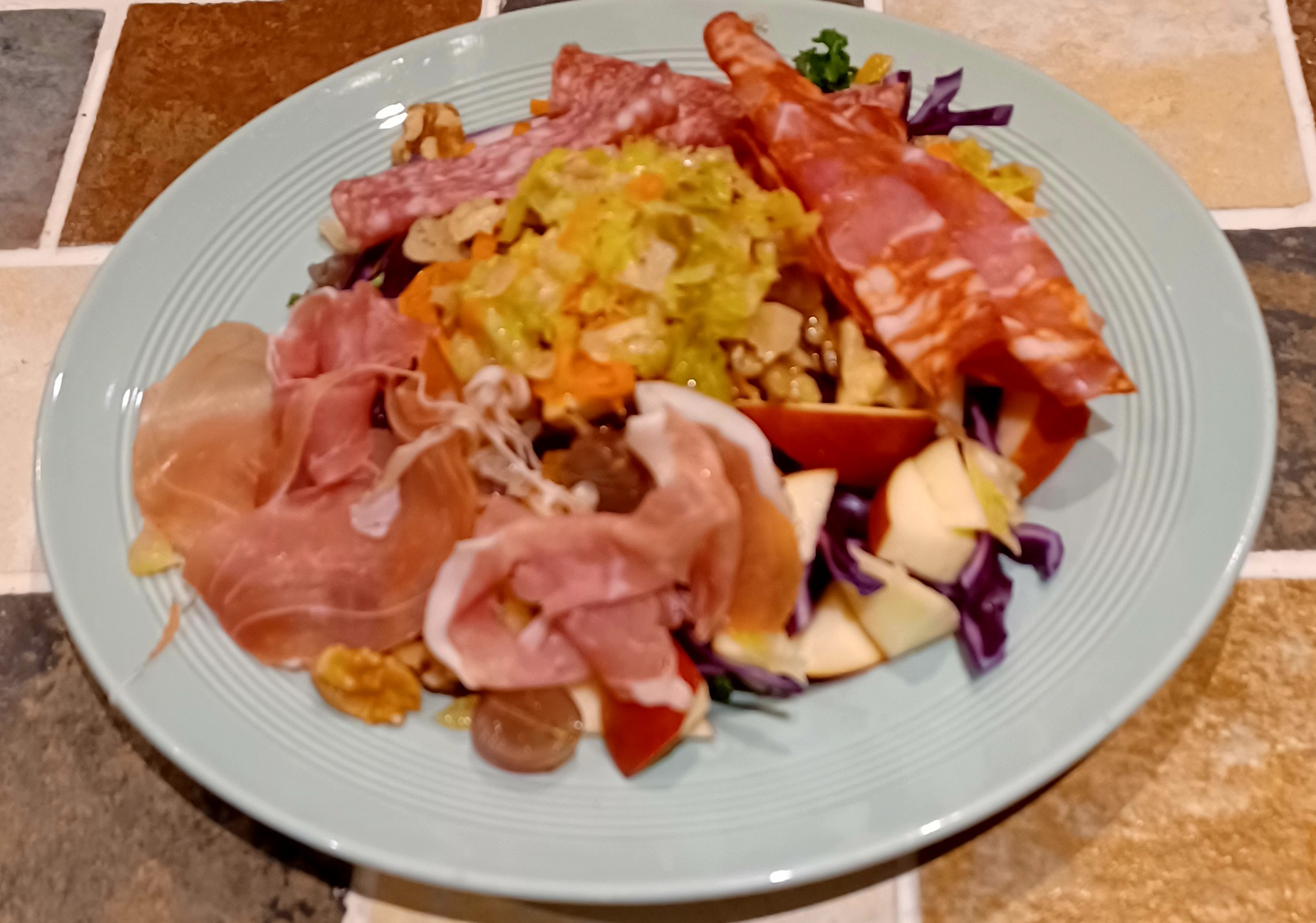
Below is a basic winter salad using some of the fresh raw seasonal fruit and vegetables that Dan and I had bought from our local farm shop at the weekend or had delivered from Riverford Organic. I dressed the salad with my basic homemade salad dressing (as detailed in the above paragraph), adding a dollop or two of home-fermented cabbage with its health-giving probiotics and a handful each of walnuts and mixed seeds for a bit of crunch. Quantities are random – it is entirely up to you how large you want your salad to be or for how many people you are catering – but this one will feed two.

Ingredients

  • A wedge of red cabbage, thinly shredded
  • A good handful of organic curly kale, thinly shredded
  • Organic carrot, sliced into thin julienne strips
  • Large stick of celery, chopped
  • 2 small local apples, cored and chopped
  • handful of organic black grapes, halved
  • Handful of walnuts, roughly chopped
  • Handful of mixed seeds
  • Two tablespoons of fermented cabbage (optional) – my homemade one is fermented with grated carrot and cumin seeds.
  • Salad dressing

1. Wash and prepare the fruits and salad vegetables and place in a large bowl.

2. Add the roughly chopped walnuts, drizzle in the salad dressing and mix into the salad to combine thoroughly.

3. Pile the salad into the middle of one platter or two large plates.

4. Spoon the fermented cabbage (if using) on to the bed of salad and sprinkle with mixed seeds.

COOK’S TIPS:-

This salad is vegan if served on its own or with sliced avocado or some falafels.

This main course salad can also be served with shaved parmesan or vegetarian substitute, some hot smoked mackerel or salmon or even charcuterie. However you choose to present your salad, it is very versatile!

Dan had Italian charcuterie with his salad!

Buon appetito!

Catherine

CREAM OF WILD GARLIC SOUP

06 Wednesday Apr 2022

Posted by catherineevans63 in Food and Drink

≈ Leave a comment

Tags

April, Coconut Milk, Cream, Food, foraging, May, Recipe, Seasonal, Soup, Springtime, Vegetables, Wild Garlic, Wild Garlic Soup

In the UK, the wild garlic (allium ursinum) or ‘Ramsons’ season is a short one: these pungent plants are usually ready for picking around the beginning of April until the end of May or early June, though it is normally at its most prolific from April until the beginning of May. Wild garlic plants have pretty white blooms and coat the shady floors of woods at springtime. Although it may also be found in scrub and hedgerows, it prefers the damper conditions of woodland and chalk soils.

Other names for wild garlic include ‘buckram’, ‘broad-leafed garlic’, ‘gypsy’s onions’, ‘wood garlic’, ‘bear leek’ and ‘stinking Jenny’. Its leaves are long, oval and pointed with untoothed edges which grow from the base of the plant and the bulb. They are sometimes confused with lily of the valley when not in flower but you will know it is wild garlic from its strong garlicky smell if you crush some of the leaves in your hand, and lily of the valley flowers are bell-shaped. Lily of the valley is poisonous so make sure you know what you are picking if you are out foraging. The flowers of the wild garlic are small and white with six petals on a thin stalk and around 25 flowers make up each rounded flower cluster on a single, leafless stalk.

Wild garlic reproduces through bulbs, bulbils and occasionally from seeds which are 2-3mm long and are black and quite flat on one side. They scatter when the parts of the plant above the ground die down. It is important not to over-forage wild garlic, which would badly affect regrowth and availability in the following year. Unfortunately, as this plant has become a highly-prized gourmet ingredient this practice is becoming a major problem in certain areas of its habitat. The whole point of foraging is to take only what you need with a respect for nature and mindfulness of its bounty, and not with ruthlessness or for large-scale material gain.

It is the leaves of the wild garlic that are eaten, with the bulbs left intact in the ground, and the taste is quite mild, similar to that of chives. It is best picked before the flowers appear, but in any case it is best to try and avoid picking stalks that bear flowers to ensure the survival of the plant in following years.

Wild garlic leaves can be eaten raw or lightly cooked; they are very versatile and can be used in a wide variety of recipes. Make sure you wash and drain them thoroughly. Some recipes might also ask you to blanch the leaves for a few minutes in boiling water. Wild garlic can be stirred into risottos or omelettes, added to lasagnes and bakes, soups and stews or used in sauces such as pesto or gremolata, or in salads and dressings. In a soup or stew they are best added at the last moment to wilt down, rather like watercress or spinach.

I particularly enjoy making wild garlic pesto which I use in salads or to smooth over my homemade pizza base before adding toppings. I also enjoy the taste of wild garlic soup so I am sharing with you one of my recipes which is prepared in a slow cooker. If you like, use coconut milk instead of double cream to finish to keep it vegan. Please see the cook’s notes at the end of the recipe for other variations.

INGREDIENTS

(Serves 3-4)

1 medium potato, peeled and cut into small chunks

1 clove of garlic, chopped finely

Large handful of foraged wild garlic leaves (or a small packet), larger stalks removed

1 onion, roughly chopped

500 ml vegetable stock (or enough to cover)

Double cream or coconut milk to finish

Sea salt and freshly ground pepper

METHOD

  1. In the crock of a small slow cooker place all the ingredients except for the wild garlic leaves and add enough cold vegetable stock to cover approx 2.5 cm above the vegetables. The stock can be made with water and a teaspoon of Swiss Bouillon granules or you can use reserved water from steamed vegetables. Season with salt and pepper. Place the lid on the crock and cook on high for 1 hour, then cook on low for a further 1-1.5 hours or until vegetables are tender. If you prefer to use hot stock, please remember to switch on your slow cooker to high to heat up 30 minutes before you add ingredients and hot liquid as the crock is heat sensitive and may crack.
  2. Meanwhile prepare the wild garlic leaves, removing any flowers and larger, thicker stalks, place in a colander and rinse thoroughly in cold running water, leave to drain.
  3. When the vegetables are tender add the wild garlic leaves to wilt down for 30 seconds or so with the lid on and switch off the slow cooker, leave the soup to cool down a little.
  4. Blend soup thoroughly until smooth with a stick blender, taste and adjust seasoning if necessary. Stir through a swirl of double cream or coconut milk, check and correct seasoning again and gently reheat on the low setting. Serve with a few garlic croutons and a chunk of good bread.

COOK’S NOTES

If you prefer your soup to have a milder flavour, replace the onion with a small finely sliced leek.

Try adding some finely chopped chives or parsley to the blended soup.

A stick of lemongrass cooked with the vegetables might add an Asian twist if you are finishing the soup with coconut milk. Remember to remove the lemon grass before blending.

Meat eaters might like to garnish the soup with a scattering of pan fried bacon bits or some crispy pancetta.

If you don’t have a slow cooker, just use a saucepan as usual. Cook the vegetables in the stock until tender. Once tender, remove from the heat and quickly add the wild garlic leaves and allow to wilt down in the residual heat. When the soup mixture has cooled slightly blitz with a stick blender, adjust seasoning, add cream or coconut milk, adjust seasoning again if necessary and gently reheat before serving with garnishes as you like.

If you have neither cream nor coconut milk, just add a splash of milk before reheating or simply reheat with its bright green colour, ladle into a warm bowl and perhaps add a dollop of natural yoghurt or creme fraiche.

One-Time
Monthly
Yearly

Make a one-time donation

Make a monthly donation

Make a yearly donation

Choose an amount

£3.00
£9.00
£60.00
£3.00
£9.00
£60.00
£3.00
£9.00
£60.00

Or enter a custom amount

£

Your contribution is appreciated.

Your contribution is appreciated.

Your contribution is appreciated.

DonateDonate monthlyDonate yearly

Sausages!

Featured

Posted by catherineevans63 in Food and Drink

≈ 3 Comments

Tags

Beef, Butchers Sundries Online, Charcuterie, Curing, Food, Haggis, Pork, Sausage-making, Sausages, Vegetables, Vegetarian haggis, Vegetarian sausages, Viscofan

Didn’t we do well?!

Back in June, my husband Dan and I celebrated our 12th wedding anniversary in Lockdown with a day of sausage-making followed by a socially-distanced barbecue with our next-door-neighbours, Aidan and Sophia.

The art of sausage-making involves some scientific know-how and there is an obvious difference between making fresh sausages and those that you do not intend to eat right away.

Fresh sausage does not normally need curing salt, just a teaspoon of sea salt, freshly ground black pepper, whatever herbs, spices and other flavourings you like such as apple, sun-dried tomatoes or ale, breadcrumbs or oatmeal and the best quality meat you can afford. However, if you intend to experiment with curing some of the mixture or wish to store fresh raw sausages in the refrigerator for 2-3 days, then you will need to substitute curing salt for sea salt. You may also store your fresh sausages in the freezer well-wrapped for up to 3 months, but freeze them on the day you have made them and consume them within the time frame. Making your own sausages also gives you control over the quality of the other ingredients as shop-bought sausages often contain more unsavoury parts of the animal such as snout, gums, connective tissue and so forth.

If you want to keep your bangers in the refrigerator for 2-3 days before eating them or intend to have a go at producing air-dried sausage, such as chorizo, it is important to add a special curing salt, such as potassium nitrate or pink curing salt, to your sausage recipe in order to avoid botulism. The amount of curing salt varies according to which curing salt you choose and which type of sausage you are making but in the case of chorizo, for example, it is common practice to add 0.5g of potassium nitrate per kg of meat or 2.5g of pink curing salt per kg of meat, which is about half a teaspoon.

The method of curing also varies and is often very precise. Chorizo is often air dried by hanging up in an area with a steady temperature of between 50 and 60F and a humidity of 65-80F, but some people prefer to use an air dryer. Temperature and humidity are very important to avoid problems such as case hardening, which occurs when the cases cure faster than the meat inside. This usually happens when there is not enough humidity and the meat inside will not cure properly, although it is more of a problem with fatter sausages such as salami.

Occasionally mould will form on the sausage casing. White powdery mould is usually safe, but if it forms simply wipe it off with apple cider vinegar. If green mould forms on the outside of the casing do likewise, but if it is another colour such as blue or black you will need to throw the sausage away.

If the sausage does end up dryer on the outside than the inside, wrap in waxed paper or cling film and pop it in the refrigerator for a few days which will usually correct the problem, as the humidity left in the sausages will even out, leaving a more balanced sausage.

Air dried sausage is ready to eat when it has lost at least 35% of its original weight, so make sure you weigh the sausage before you hang it up to dry and then weigh it again before cutting, when it is firm to the touch by squeezing it.

If you are thinking about curing your own sausages in this way, making a small batch of fresh sausage (containing curing salt instead of sea salt and a variety of other seasonings) for eating right away and air drying one or two of the links to experiment, may be a step forward.

Dan and I chose to make fresh sausages by hand after grinding the ingredients in a food processor, as we did not have a sausage-maker or meat-grinder.

Mixing the ingredients – this was the beef mixture

Because I wanted to make some vegetarian haggis sausages for myself, I bought one stick of Viscofan 30mm diameter 100% plant-based sausage skin from the Ebay UK seller butcherssundries_online, which cost me £8.99 including free p&p for one 15.24 metre stick. Viscofan are world-leaders in producing the finest quality sausage skins, using state-of-the-art technology to form their ingredients into casings. The casing I bought is 100% vegetarian, gluten-free, GMO-free, allergen-free and are also suitable for vegans. They are also marketed as having an excellent natural look with good frying qualities and a tender bite. The all-one-length stick is sectioned at approximately 2.5 cm intervals in folded form, which we found produced an average yield of 6 sausages and also allowed us to cut off the length of casing we needed without wasting any, knotting the cut-off end to secure before stuffing.

We started with the ingredients for the vegetarian haggis sausages, then the pork and tomato and finally the beef and red wine ones, washing the food processor thoroughly afterwards between each batch of ingredients to avoid cross-contamination. As we had no sausage-maker we first tried piping the mixture into the skin, which wasn’t very effective, but I had a brainwave and we inserted a small funnel into the open end of the casing and pushed the mixture through the funnel with clean fingers and the handle of a wooden spoon. We made sure the sausage casing was well-filled before twisting at each interval to form the individual sausage shapes, but this was the tricky part as the casing seemed less pliable than we expected so we needed to twist it several times to stay in place.

Stuffing the skins

All the sausages cooked perfectly on the barbecue, the skins did not burst and had a tender bit. We set the grill higher over the coals to allow the sausages to cook evenly. There is nothing worse than a sausage burnt on the outside and still half-cooked on the inside. We wrapped the haggis sausages in foil and placed them in a foil tray with some water and steamed them over the barbecue. All the sausages had a good consistency and tasted delicious and we all enjoyed what we ate. I served all the sausages with a good vegetarian red wine reduction, a foil tray of onions gently fried and then placed over the barbecue covered with heavy-duty foil and some creamy mashed potato, and we shared a good bottle of Champagne.

Below are my sausage recipes – simply combine all ingredients in a food processor or meat grinder before making into sausages. I eyeballed most of the ingredients based on instinct, but if you’re not a confident cook then feel free to use your own weights and measures.

BEEF AND RED WINE SAUSAGES

  • 500g minced beef – drizzled with a good glug of Merlot and allowed to marinate overnight
  • A good handful of fresh breadcrumbs or oatmeal
  • Fresh thyme, leaves only
  • Sea salt and freshly ground black pepper

PORK AND TOMATO SAUSAGES

  • 500g minced pork
  • A good handful of fresh breadcrumbs or oatmeal
  • 3 tbsp tomato paste
  • Chopped sun-dried tomatoes if liked
  • Fresh thyme and chopped sage, leaves only
  • Sea salt and freshly ground black pepper

VEGETARIAN HAGGIS SAUSAGES

  • Can butter beans, drained and mashed
  • A good handful of oatmeal
  • Chopped garden herbs, leaves only – thyme, rosemary, marjoram
  • A good handful of vegetable suet
  • A glug of sunflower oil
  • 1 tsp ground allspice
  • Sea salt and lots of freshly ground black pepper

We have since invested in a combined sausage-maker and meat-grinder and had a date making turkey and chorizo sausages seasoned with hot and smoked paprika, which turned out really well. We gave some to my brother and he loved them!

One-Time
Monthly
Yearly

Make a one-time donation

Make a monthly donation

Make a yearly donation

Choose an amount

£3.00
£9.00
£60.00
£3.00
£9.00
£60.00
£3.00
£9.00
£60.00

Or enter a custom amount

£

Your contribution is appreciated.

Your contribution is appreciated.

Your contribution is appreciated.

DonateDonate monthlyDonate yearly
Basil Gnocchi with Mediterranean Vegetables

Featured

Posted by catherineevans63 in Food and Drink, Uncategorized

≈ 5 Comments

Tags

conversation, Food, Gluten-free, Recipe, talk, Vegan, Vegetables

During the Lockdown period I have seen a few TV programmes featuring celebrity chefs preparing gnocchi.

Now, I have tried pre-packaged gnocchi from the supermarket several times in the past but it was never to my liking. It often has a strange, slimy texture and is under seasoned, tasting of very little at all; an underwhelming dining experience, it must be said.

For me, texture is a very important consideration when preparing meals. If something looks and tastes ‘wrong’ to my palate I am unable to eat it and I am sure many people share my sentiments. Gnocchi has usually had this effect upon me, thus I tend to avoid it.

However, recently having watched TV programmes showcasing tempting plates and inventive recipe ideas with gnocchi, and then discovering that gnocchi is a slightly healthier alternative to traditional white pasta, I did wonder whether I might be missing out on a taste sensation and might perhaps have more luck making my own gnocchi and, at the same time, make it gluten- and egg-free, so I decided to give it a go.

Gnocchi are little Italian soft dough dumplings often made with a blend of semolina or wheat flour, mashed potato, egg and seasoning and can be fried, baked or boiled. Other ingredients might include cornmeal or breadcrumbs, cheese or egg, and flavourings such as vegetables, herbs, cocoa or prunes.

I used Doves Farm plain (all purpose) gluten-free flour which is a blend of rice, potato, tapioca, maize and buckwheat and is also suitable for a Kosher diet. Recipes online suggest baking rather than boiling gluten-free gnocchi but I saw no reason why the little dumplings could not be boiled as long as handled with the love and respect any handcrafted product deserves.

One of the most important things is to use floury potatoes and make sure they steam dry before mashing and that it is well-seasoned with salt and pepper. The potato can be boiled first or baked in its jacket in a microwave oven before mashing A potato ricer, if you have one, makes it easier to get a nice smooth texture with no lumps, otherwise use a conventional potato masher and some elbow grease, but for my recipe do not add milk or butter or any beaten egg. Simply combine the potato with the plain flour, add chopped sage or any chopped herbs of your choice, and season well with sea salt and freshly ground pepper.

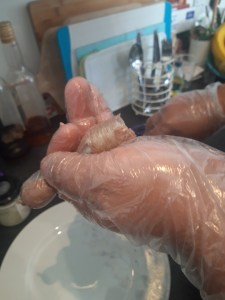
Form the gnocchi dough into little balls or lozenge shapes and use the back of a fork to create a crinkle effect, before boiling in a pan of salted water for a couple of minutes. When they are ready, the gnocchi will rise to the surface. Remove them with a slotted spoon on to kitchen paper to drain and then serve with any sauce of your choice – or even a simple drizzle of garlic infused olive oil and torn basil leaves, or a little pesto or sun dried tomato tapenade.

For a heartier plate and to keep this recipe vegan, any tomato-based sauce goes well with gnocchi, whether you roast whole cherry tomatoes in an oven with garlic and balsamic vinegar or use tinned chopped tomatoes. For a vegetarian, gnocchi can be enjoyed with roasted butternut squash and goat’s cheese or perhaps some spinach and ricotta. I decided to serve the gnocchi simply with a side of roasted Mediterranean vegetables – diced aubergine (eggplant), roughly chopped onions, tomatoes, courgette, tomatoes and bell peppers and a drizzle of balsamic vinegar.

I found the gnocchi cheap to make and easy to prepare, and the time taken was worth the effort as the result was delicious. I have discovered a liking for freshly-prepared gnocchi, they are tasty, filling and versatile and I will enjoy experimenting with different flavour and texture combinations.

Ingredients (serves 4)

Gnocchi 2
Gnocchi 3
Gnocchi 4
Gnocchi 5
Gnocchi 6
Gnocchi 7
Gnocchi 8

For the gnocchi

  • 400g   Potatoes, mashed
  • 50g     Gluten-free Plain flour
  • Salt and freshly-ground black pepper
  • Finely chopped fresh or dried basil

For the vegetables

  • 1 Aubergine diced into 2cm chunks
  • 2 courgettes diced into 2cm chunks
  • Whole cherry tomatoes or quartered vine-ripened tomatoes
  • 2 red onions, roughly chopped into chunks
  • Red and Yellow Bell Pepper, deseeded and sliced into strips
  • Crushed garlic cloves (optional)
  • Olive oil
  • Balsamic Vinegar
  • Sea salt and freshly ground black pepper
  • Torn basil leaves (to serve)
  1. Boil floury potatoes in their skins in salt water, drain thoroughly and return to the pan to steam dry. Alternatively, microwave potatoes in their skins until cooked through.
  2. Wash and prepare the vegetables, drain well on kitchen paper and place in a roasting tin with some crushed garlic cloves if liked and a good glug of olive oil, a splash of balsamic vinegar and season with sea salt and freshly ground black pepper. Place in a medium oven and roast for 20-25 minutes or until tender.
  3. On the hob, heat a large pan of salted water and bring to the boil.
  4. Meanwhile, as soon as the potatoes are cool enough to handle, peel the skins away with clean hands and either push the potatoes through a potato ricer or mash to remove any lumps. Turn potatoes out on to a large board.
  5. Measure out 50g plain flour on to the board and gently mix into the potatoes, along with chopped fresh or dried basil to your liking and season well with salt and freshly ground pepper. Add a little more flour if you think it is necessary, but only add one tablespoon at a time to avoid the dough becoming too dry.
  6. Carefully knead the dough for a few minutes until pliable and then roll into four thin sausage shapes 2-3 cm thick and cut each sausage into 3cm slices. Then either roll into balls or carefully mould into lozenges, using the back of a fork to create grooves which will help the sauce to stick to the dumplings.
  7. Carefully place the gnocchi in the pan of salted water and boil for about 2 minutes. They are ready when they rise to the surface and they will have puffed up a bit. Cook the gnocchi in two batches of two servings to ensure they do not stick together.
  8. Remove from the pan with a slotted spoon, toss with a little garlic-infused extra virgin olive oil and serve with the Mediterranean vegetables and torn basil leaves.


Donate with PayPal

One-Time
Monthly
Yearly

Make a one-time donation

Make a monthly donation

Make a yearly donation

Choose an amount

£3.00
£9.00
£60.00
£3.00
£9.00
£60.00
£3.00
£9.00
£60.00

Or enter a custom amount

£

Your contribution is appreciated.

Your contribution is appreciated.

Your contribution is appreciated.

DonateDonate monthlyDonate yearly
51.345703 1.429011
← Older posts
Donate with PayPal

Blog at WordPress.com.

Privacy & Cookies: This site uses cookies. By continuing to use this website, you agree to their use.
To find out more, including how to control cookies, see here: Cookie Policy
  • Subscribe Subscribed
    • Catherine Evans
    • Join 42 other subscribers
    • Already have a WordPress.com account? Log in now.
    • Catherine Evans
    • Subscribe Subscribed
    • Sign up
    • Log in
    • Report this content
    • View site in Reader
    • Manage subscriptions
    • Collapse this bar
 

Loading Comments...